
By Cremilda Macuácua, China Africa News
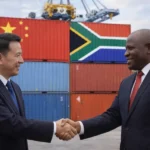
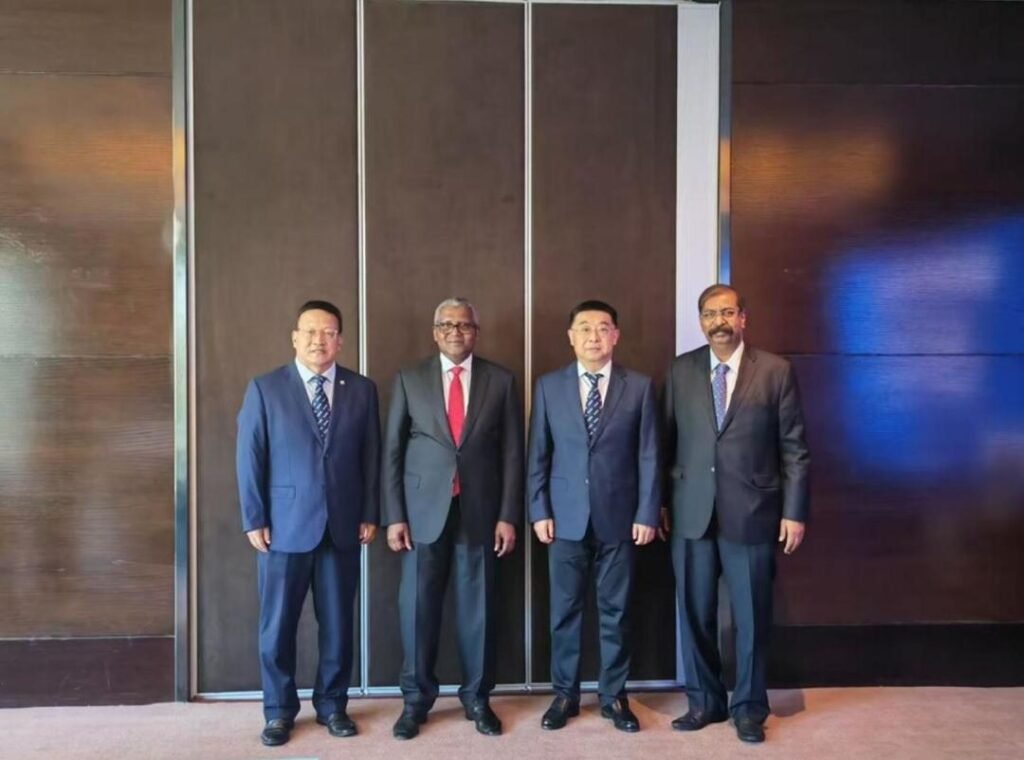
February 17, 2026, Lagos — Nigeria’s leading industrial conglomerate, the Dangote Group, has signed a $400 million equipment supply agreement with China’s heavy machinery manufacturer XCMG, the companies confirmed on February 17. The deal will see XCMG provide advanced construction and industrial equipment to support the expansion of the Dangote Refinery and associated infrastructure projects.
In a statement, Dangote officials described the partnership as “a strategic step toward accelerating project delivery and strengthening Nigeria’s industrial capacity,” while XCMG said the agreement reflects its “long-term commitment to Africa’s infrastructure modernization and industrial growth.”
The refinery project, spearheaded by Nigerian industrialist Aliko Dangote, is one of the largest single-train refineries in the world and a cornerstone of Nigeria’s ambition to reduce reliance on imported refined petroleum products. Securing large-scale, specialized construction equipment from China highlights both the technical scale of the expansion and the growing interdependence between African industrial projects and Chinese manufacturing capacity.
For XCMG, one of China’s largest construction equipment manufacturers, the agreement deepens its commercial footprint in Africa’s biggest economy. For China more broadly, deals of this magnitude reinforce its role not only as a major trading partner to African nations but also as a provider of the industrial machinery and technical systems that underpin large-scale development.
The significance of the agreement extends beyond procurement. In recent years, China–Africa engagement has increasingly focused on what policymakers describe as productive capacity cooperation supporting sectors that enable African economies to refine, manufacture, and process domestically rather than export raw commodities. Heavy equipment partnerships often generate secondary effects, including technical training, maintenance contracts, integration into global supply chains, and local employment opportunities. In that sense, the Dangote-XCMG arrangement embeds Chinese industrial technology within a flagship African mega-project that carries regional energy implications.
The timing also aligns with broader economic signals. China recently announced plans to eliminate tariffs on imports from 53 African countries beginning May 1, 2026, a policy designed to expand African access to Chinese markets. When viewed alongside large-scale industrial cooperation agreements such as this one, the pattern suggests a more reciprocal framework: expanded market access for African exports on one hand, and support for industrial expansion within Africa on the other.
For Africa, the deal reinforces a development trajectory centered on industrialization, energy security, and infrastructure expansion priorities long identified in continental policy frameworks. For China, it consolidates commercial and strategic ties with a continent that is increasingly central to global growth dynamics.
As construction advances, the partnership between Dangote Group and XCMG may come to symbolize a broader shift in China–Africa relations. What began decades ago as trade dominated by raw materials and basic infrastructure has evolved into collaboration around complex industrial ecosystems and high-capital projects. The $400 million agreement is therefore not only a commercial contract; it is a marker of how China and Africa are redefining economic cooperation in a more integrated and industrially focused direction.