
By Senior Editor, China Africa News
KIGALI, Rwanda,Sept 21, 2026 — The setting was a familiar one in Rwanda: government officials, business executives and diplomats gathered in a Kigali room to talk about investment and development.
But this time, the subject was something more revealing.
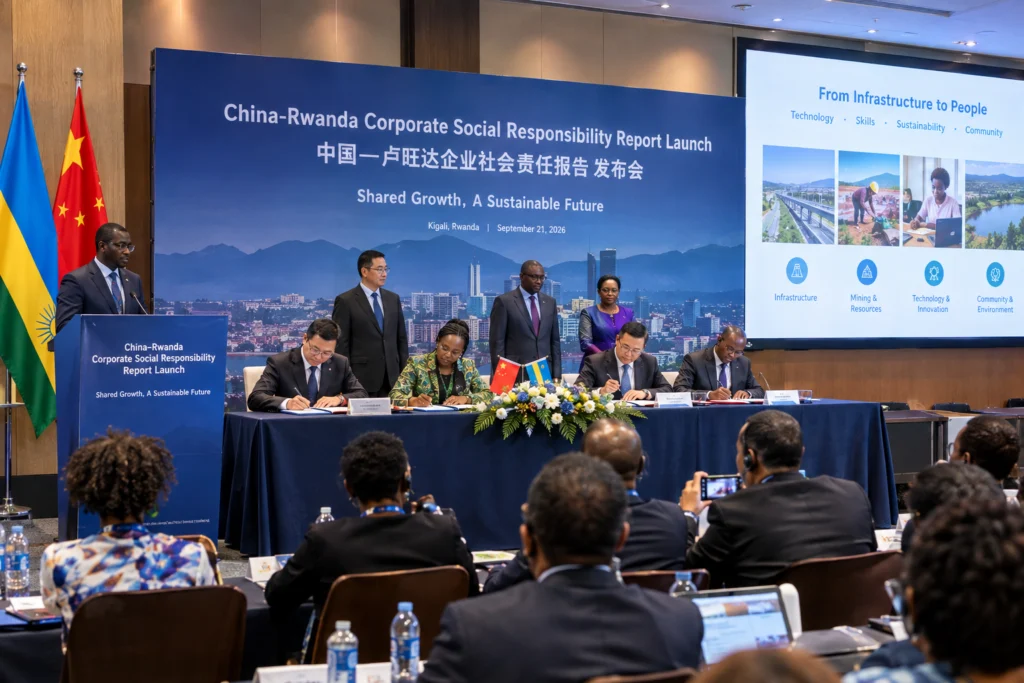
Chinese companies operating in Rwanda were presenting their first collective Corporate Social Responsibility report, while mining companies signed a sustainability initiative promising greater attention to communities, workers, environmental protection and local business participation.
An artificial-intelligence lesson followed
Taken together, the events offered a glimpse of how China’s economic presence in Rwanda is evolving from the roads, bridges and mines for which it has become widely known toward a broader model built around technology, skills, social responsibility and institutional relationships.
The gathering on Sept. 18 brought together about 120 people, including representatives of Chinese companies, Rwanda’s Private Sector Federation, government ministries and the China Chamber of Commerce in Rwanda. The event was organised by the Chamber and the Alliance of Chinese Business in Africa for Social Responsibilities.
The report highlighted decades of Chinese commercial activity in Rwanda. China Road and Bridge Corporation, for example, is credited with completing more than 90 projects and about 1,500 kilometers of roads. Other companies cited large numbers of local employees, while Chinese-backed projects have also expanded into energy, manufacturing, health and technology.
There is a clear message in the report: Chinese companies want their presence in Rwanda to be measured not only by what they build or extract, but by what they contribute to the society around them.
That message is particularly important in mining
At the same gathering, Chinese mining companies signed a sustainability self-discipline initiative covering environmental protection, workers’ rights, ethical business practices, community engagement and compliance with Rwandan law.
The commitments come at a consequential moment for Rwanda and for Africa more broadly. Critical minerals have become central to the global race for new technologies, energy systems and industrial supply chains. Rwanda, meanwhile, wants its mineral sector to generate more value inside the country through processing, employment, skills and stronger participation by domestic companies.
The Rwanda Private Sector Federation has argued that responsible investment should go beyond charitable donations and include local procurement, workplace safety, decent employment, environmental protection and knowledge transfer.
That is a significant distinction
The question facing African economies is increasingly not whether foreign capital arrives. It is what remains after it does.
For China, the question is also changing. Its companies are no longer entering African markets only as contractors building infrastructure. They are becoming employers, technology providers, investors, trainers and participants in local commercial ecosystems.
The China Chamber of Commerce in Rwanda sits near the centre of that network.
Alongside Chinese companies, the wider ecosystem includes the Chinese Embassy, the Confucius Institute, the China Medical Team, the Rwanda-China Alumni Organization and other business and educational institutions. Their activities span commerce, health, education, skills development and community engagement.
The inclusion of artificial intelligence at the Kigali event was therefore telling.
Through the Luban Classroom, Huawei Rwanda delivered an AI session, adding a distinctly modern dimension to an event otherwise centred on corporate responsibility and mining.
It reflects Rwanda’s own ambitions. The country has placed technology, innovation and skills at the heart of its development strategy. For Chinese companies, helping develop those capabilities can also create a workforce suited to increasingly sophisticated industries.
The relationship is consequently becoming more layered.
It is no longer simply about Chinese companies building something in Rwanda and leaving.
It is about creating networks of businesses, workers, institutions, students and technology — that can make the relationship more durable.
This year also marks 55 years of diplomatic relations between Rwanda and China, giving the latest business initiatives an additional political backdrop.
Yet the success of this next phase will not ultimately be measured by speeches, reports or ceremonies.
It will be measured by whether Rwandan workers acquire valuable skills, whether domestic businesses enter Chinese-linked supply chains, whether mining communities see tangible benefits, whether environmental standards are respected and whether more value from Rwanda’s resources remains within Rwanda.
That is the real test of the new language of corporate responsibility.
In Kigali, Chinese companies are making the case that their relationship with Rwanda is about more than roads and mines.
The next question is whether the results on the ground will make that case convincing.
The broader relationship
The business story is part of a much larger relationship. Rwanda and China established diplomatic ties in 1971 and 2026 marks 55 years of formal relations. Over that period, cooperation has expanded from traditional diplomatic ties into infrastructure, trade, health, education, technology and investment. The latest initiatives suggest that both sides are now seeking to deepen that relationship beyond government-to-government cooperation bringing companies, universities, professional networks and local communities more directly into the partnership