
By Senior Editor, China Africa News
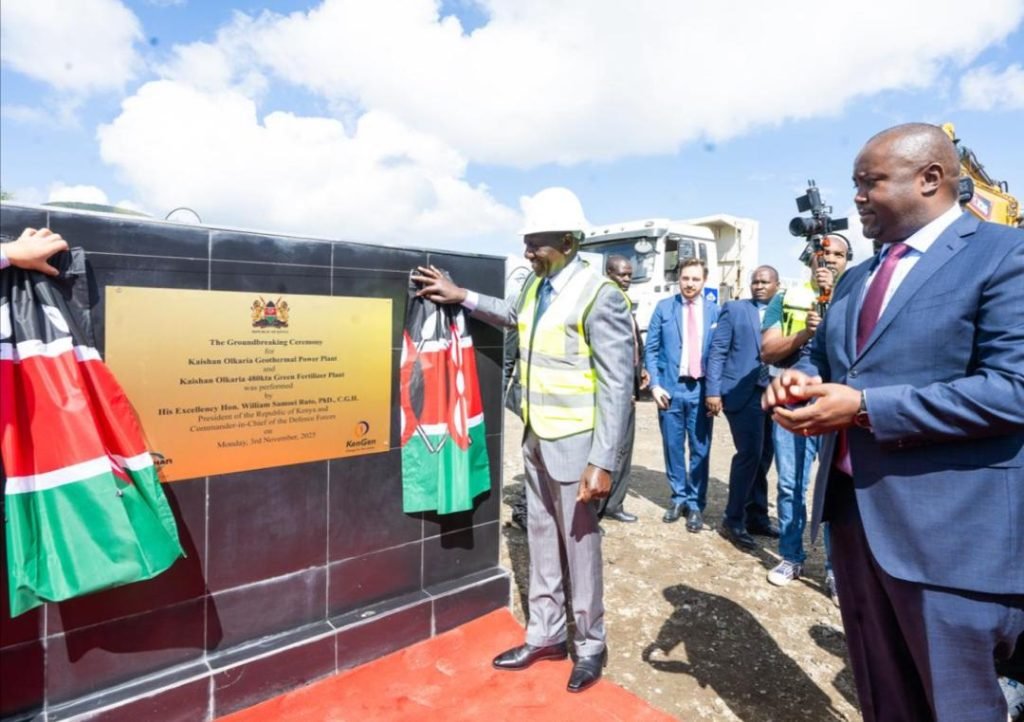
Nakuru& Beijing- China and Kenya have once again demonstrated their growing partnership by inaugurating a landmark green-fertiliser venture in Kenya’s Rift Valley. On Monday, at the geothermal-rich site of Olkaria in Naivasha, Nakuru County, Kenyan state energy firm KenGen and China’s Kaishan Group launched the groundbreaking for an US $800 million facility that will produce green ammonia and fertiliser powered by geothermal energy.
Standing before government officials and industry leaders, President William Ruto described the initiative as “a defining moment for Kenya’s green industrial transformation.” He noted that for years Kenyan farmers, who form the backbone of the nation, have “borne the burden of unpredictable fertiliser prices, supply shocks and global volatility.” He stressed that each shipment of imported fertiliser “represents a cost to our Treasury and a lost opportunity for our people.” Looking ahead, he projected the plant will create over 2,000 jobs, cut the country’s fertiliser import bill by more than KSh 60 billion annually, and reinforce Kenya’s place at the forefront of climate-smart innovation on the continent.
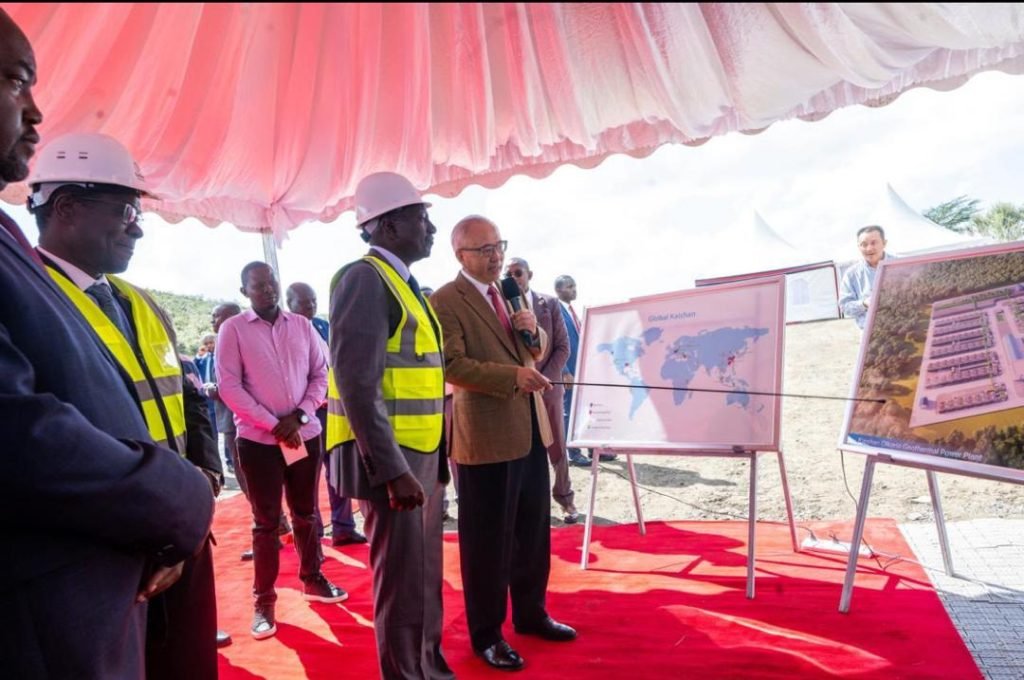
From China’s side, Tang Yan, General Manager of Kaishan Group, offered a glimpse of the technological ambition behind the project. “We will recapture the non-condensable gases in the geothermal steam to produce carbon dioxide, which will feed into the fertiliser plant,” he explained. “This means zero emissions from the geothermal power plant no waste, no pollution a closed system where everything has a purpose.”
The facility will be powered by approximately 165 MW of geothermal steam and is designed to produce up to 480,000 tonnes of fertiliser annually (equivalent to more than nine million 50 kg bags). By doing so, Kenya aims to reduce its heavy dependence on imported fertiliser it imported more than 600,000 tonnes in 2023, and 443,000 tonnes in the first half of 2025 alone. The project is also expected to avoid over 600,000 tonnes of CO₂ emissions each year roughly equivalent to removing 130,000 petrol/diesel cars from the roads.
Beyond the numbers, the venture signals a broader shift: Kenya moving from being merely an exporter of power or an importer of finished agricultural inputs, to a country globally competitive in green industrial manufacturing. For China, the collaboration illustrates how its firms are extending their reach in green hydrogen, ammonia and fertiliser technologies and working with African partners to build value-added industry, not just infrastructure.
The partnership draws on deeper diplomatic and economic ties: over the years Kenya has sought to build up renewable energy capacity, green industry and food-security resilience, while China has been a major source of clean-energy and agricultural-technology investment. With this new fertiliser plant, Kenya is positioning itself to retain more value in its agricultural supply chains, mitigate exposure to global price shocks, and step into the role of manufacturing nation in the green economy.
In sum, what broke ground at Olkaria this week is far more than a fertiliser factory. It is a symbol of Kenya’s ambition to industrialise sustainably and of China’s role in that transformation. As President Ruto put it, this project will provide Kenyan farmers with a steady, local supply of fertiliser, reduce the burden of imports on the treasury, and strengthen Kenya’s competitive edge while setting one of Africa’s first major applications of geothermal power for chemical manufacturing.