

By Senior Editor, China Africa News
Nairobi-The Chinese automotive company Jetour has launched in Kenya, marking a new chapter in the country’s automotive and mobility story. At a gathering in Nairobi on November 8 2025, the brand unveiled four new SUV models the T1, the T2, the Dashing and the X70 under the local distribution of Global Motors Center Limited.
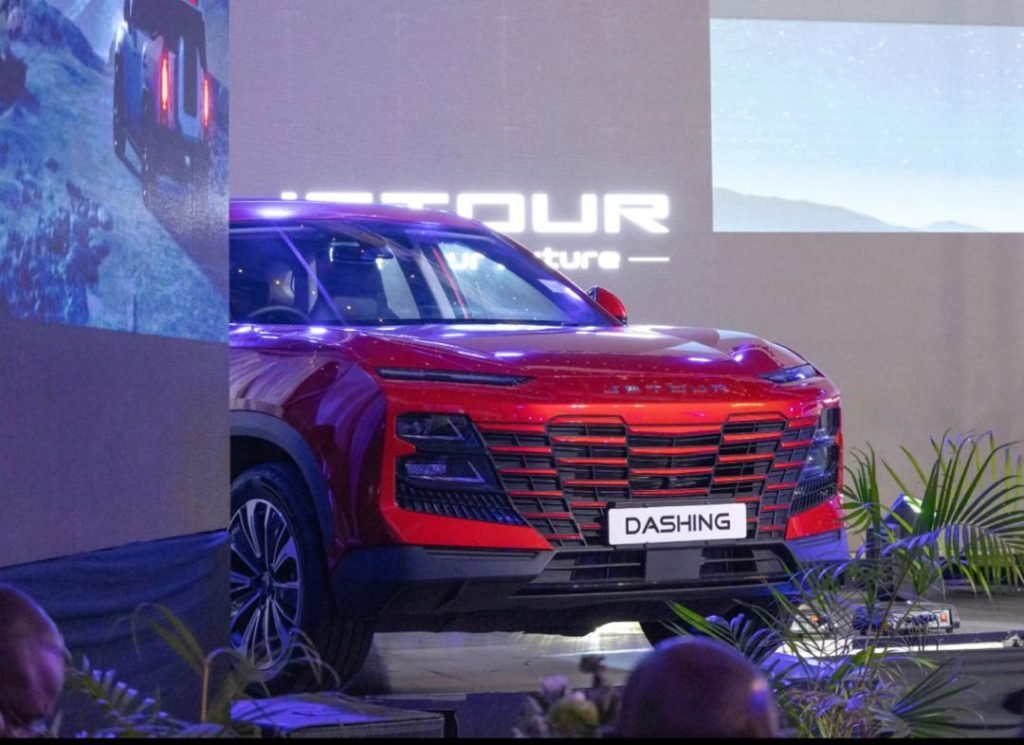
At the event, Mr Erastus Gatebe, Industrialisation Secretary in Kenya’s Ministry of Investment, Trade and Industry, noted that Jetour’s entry into Kenya was a signal of growing confidence among foreign investors in the local motor vehicle industry.Jetour International’s Andy Yuan emphasized the brand’s aim to combine advanced engineering, intelligent technology and affordability in these vehicles, tailored to meet Kenyan drivers’ needs. Farooq Sheikh, managing director of Global Motors Center, pointed out that his company was investing in after-sales support, spare parts availability and a broader service footprint to ensure that Jetour owners in Kenya would have peace of mind.
This launch speaks not just of new cars arriving on Kenyan roads, but of several deeper threads. For Kenyan transportation, these SUVs arrive at a time when demand for vehicles that can handle both urban commutes and mixed terrain travel is increasing. A model like the X70 or T2, with higher ground clearance and versatility, fits roads that are partly paved, partly unpaved, and transport needs that go beyond city-centre driving. For everyday mobility, that means Kenyan families and professionals may have access to vehicles that combine comfort, modern features and the durability required in local conditions.
Moreover, Jetour’s stated intention to pursue local assembly in Kenya underscores a commitment to the local industry beyond mere imports. By setting up assembly facilities, the brand aims to contribute to job creation, skills development, and growth of a domestic parts and service ecosystem. That aligns well with Kenya’s broader industrialisation agenda, which encourages value addition and local production rather than just finished-vehicle imports.
To understand the background: Jetour is a brand founded in 2018 as a sub-brand of Chery Holding Group in China. Its focus has been on SUVs with a “Travel+” mindset: combining lifestyle, mobility, technology and value. In its relatively short existence, the company has expanded into multiple global markets and built a reputation for offering feature-rich vehicles at competitive prices.
From the perspective of Kenya–China cooperation, this launch fits into a broader pattern of deepening economic and industrial ties. China has been a major partner for Kenya in infrastructure, manufacturing, trade and investment. The vehicle-assembly ambition by Jetour aligns with Kenya’s drive to deepen manufacturing, support local employment and reduce the import burden of fully built vehicles. In turn, the Kenyan government sees such investments as reinforcing its agenda of value-addition, local industrial capacity building, and job creation.
Looking ahead, several expectations emerge. If Jetour delivers on its service-network promise bringing in dealerships and service centres in towns beyond Nairobi (such as Mombasa, Kisumu, Nakuru, Eldoret) then Kenyan motorists will be more confident in buying the brand, especially in regions outside the capital. The pricing of the models, their resale value, reliability in Kenyan conditions, and availability of parts will all influence how successful Jetour becomes. If assembly takes off locally, that could lower costs, improve lead-times for parts and strengthen Kenyan automotive supply-chains.
On the transportation front, the entry of Jetour could stimulate competition among SUV brands, potentially driving better value for consumers and more options for Kenya’s rising middle class. More reliable, modern SUVs could also enhance mobility for service sectors, logistics, and private transport across a variety of terrains.
However, the challenge remains that a new brand must build trust. Kenyan consumers often prioritise reliability, extensive service networks and strong resale value. Jetour’s success will therefore hinge on execution: not just in selling vehicles, but in supporting them long-term in Kenya’s conditions.
In sum, the launch of Jetour in Kenya is more than a new lineup debut. It’s a signal of increased industrial cooperation between Kenya and China, a step forward for Kenya’s automotive industry ambitions, and a potential benefit for Kenyan transport and mobility. If the promise is delivered, it could shape more than just roads-it could shape manufacturing, skills and the future of the SUV segment in East Africa.