
By staff writer,China Africa News
ACCRA, Ghana, August 22, 2026 — Ghana is seeking to deepen its medical and technological cooperation with China, arguing that stronger partnerships could help West Africa move beyond dependence on imported healthcare products and build the local capacity needed to confront the region’s persistent health challenges.
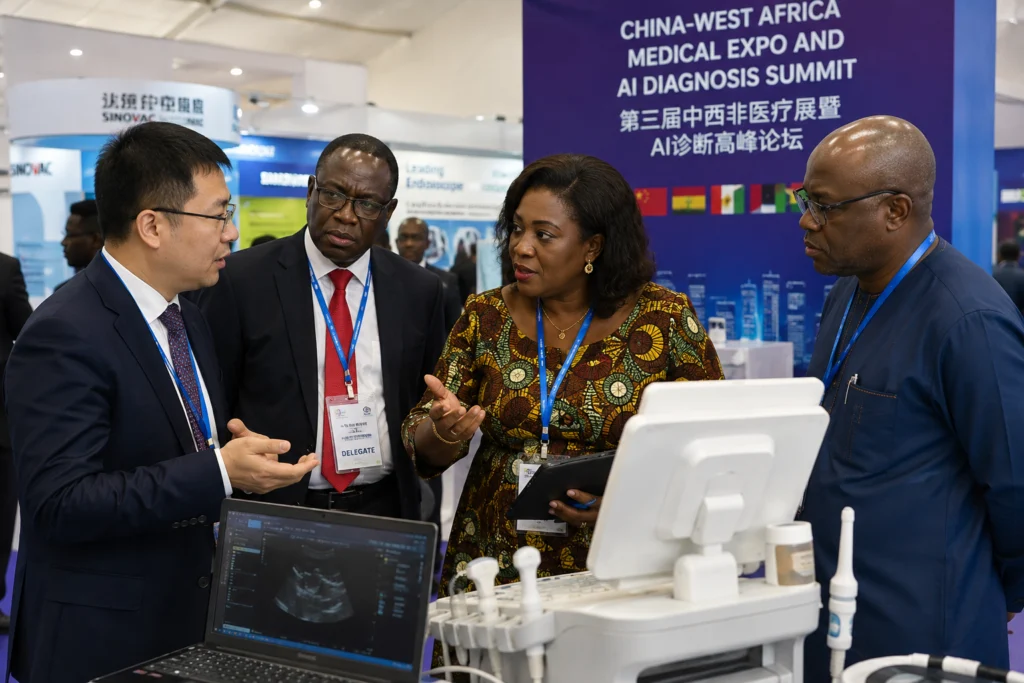
The proposal was advanced at the third China-West Africa Medical Expo and AI Diagnosis Summit, held in Accra from Aug. 19 to 21, where health officials, investors, medical professionals and technology companies from Ghana and other West African countries gathered to discuss the future of healthcare cooperation.
As reported by Xinhua News Agency, Ghana’s Deputy Health Minister, Grace Ayensu-Danquah, called for a broader model of cooperation that would include local manufacturing, technology transfer, research, professional training and investment in technical capacity.
The emphasis reflects a growing recognition in Africa that improving healthcare cannot depend solely on importing medicines, equipment and technology. Countries also need the skills, infrastructure and industrial capacity to produce, operate and maintain those technologies at home.
“Local capacity” has consequently become an important part of Ghana’s vision for its engagement with China.
Beyond importing medical products
For years, African health systems have relied substantially on imported medicines, diagnostic equipment and other medical supplies. While international trade remains essential, Ghanaian officials are increasingly interested in partnerships that can establish a more durable domestic foundation for healthcare.
The cooperation proposed at the summit would seek to encourage the assembly and manufacture of medical products in Ghana, while expanding opportunities for joint research and professional training.
Such an approach could have consequences beyond the health sector. Local production could create jobs, develop technical expertise and reduce vulnerabilities in medical supply chains, while regional cooperation could allow Ghana to serve markets across West Africa.
The broader objective, officials said, is to create a healthcare system that is not only better equipped but also more resilient.
Artificial intelligence enters the discussion
Artificial intelligence was another major focus of the summit, reflecting the growing interest in technologies that could change how medical diagnosis and treatment are delivered.
Chinese pharmaceutical, medical-engineering, health-technology and AI companies presented their products and technologies during the event. For countries where specialist doctors and advanced diagnostic facilities are unevenly distributed, AI-assisted healthcare could offer new ways of extending medical expertise to underserved communities.
But technology alone is unlikely to solve the region’s healthcare problems. Its effective adoption will require reliable infrastructure, trained personnel, appropriate regulation and investment to ensure that sophisticated systems remain accessible and sustainable.
That makes the emphasis on training and technology transfer particularly significant.
A wider West African conversation
The summit also drew participants from countries including Togo, Nigeria, Sierra Leone and Mali, underscoring the regional dimension of the discussions.
Healthcare challenges frequently cross national borders in West Africa, and improvements in manufacturing, medical training, research and digital health could potentially benefit several countries if cooperation is coordinated at the regional level.
Ghana’s proposal therefore comes at a moment when African governments are increasingly looking to international partnerships not simply for financial assistance, but for investment and expertise that can strengthen domestic institutions and industries.
The discussions also touched on traditional Chinese medicine. Jiang Sihong, president of the Health Community of West Africa and an organiser of the summit, proposed exploring cooperation in the field and the establishment of appropriate traditional Chinese medicine treatment centres in Ghana.
From promises to measurable results
The real test of the summit, however, will come after the delegates leave Accra.
For Ghana, successful cooperation would mean more than agreements and exhibitions. It would mean factories producing medical supplies, researchers working jointly across borders, health professionals receiving advanced training and new technologies reaching patients who need them.
Ayensu-Danquah said the initiative should ultimately produce practical outcomes in areas including investment, research, technology transfer, local manufacturing and professional development.
That emphasis may prove to be the most consequential aspect of the meeting.
China brings extensive experience in manufacturing, engineering and technology, while West Africa offers growing healthcare markets and a large population whose medical needs remain significant. If the two sides can translate those complementary strengths into sustained investment and local capacity, the partnership could extend well beyond the exchange of medical products.
For Ghana and its neighbours, the ambition is straightforward: to make international health cooperation less about receiving what others produce and more about developing the ability to produce, innovate and solve problems at home.