
By Cremilda Macuácua,China Africa News
Johannesburg, August 9, 2026 — South Africa is looking to China for more than money as it embarks on one of the most ambitious transformations of its electricity sector in decades.
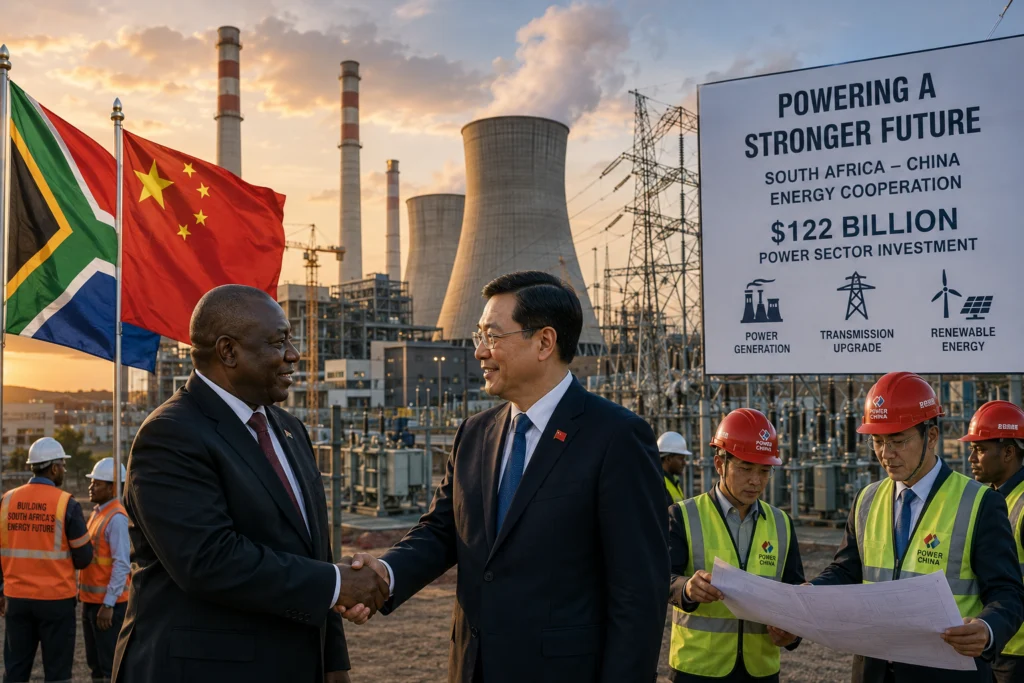
The country estimates that about R2.2 trillion ($122 billion) will be needed to expand generation, modernize the power grid and build the infrastructure required to support a growing economy. Electricity and Energy Minister Kgosientsho Ramokgopa has identified China as a potentially important partner in meeting that challenge.
The urgency is clear. South Africa has spent years struggling with an unreliable electricity system, aging infrastructure and insufficient generation capacity. The government now wants to add about 105 gigawatts of new generation capacity by 2039, with solar and wind expected to play an increasingly important role.
But producing more electricity is only half the battle.
South Africa estimates that around R440 billion will be required to build roughly 14,500 kilometers of new transmission infrastructure. Without those power lines and substations, new electricity projects cannot reliably deliver power to homes, businesses and industries.
China’s experience makes it an attractive partner. Chinese companies have become major players in solar energy, batteries, transmission equipment and other technologies that South Africa needs as it moves toward a more modern and diversified electricity system.
Yet Pretoria is making clear that it does not want a relationship based simply on importing Chinese equipment.
The government is seeking investment that can create local manufacturing, technical skills and jobs, allowing South African companies and workers to participate in the country’s energy transition. The hope is that factories producing components, batteries or other energy technologies could become part of a broader industrial revival.
That makes the energy program about more than keeping the lights on. It is also an attempt to use the country’s electricity crisis as an opportunity to attract investment and create new industries.
For China, South Africa represents a significant potential market at a time when Chinese energy and infrastructure companies are looking for opportunities abroad. For South Africa, the partnership could provide access to the capital and expertise needed to tackle an enormous infrastructure deficit.
But the numbers alone will not determine whether the plan succeeds. The country will need efficient institutions, reliable regulation, financing and the ability to turn investment commitments into projects on the ground.
Ultimately, the success of South Africa’s energy transformation will be measured in much simpler terms: whether businesses can operate reliably, whether factories can expand, and whether ordinary households can finally trust that the electricity will be there when they need it.
For a country that has lived through years of power shortages, that would be more than an infrastructure achievement. It would be a sign that the economy is finally moving forward.