
By Senior Editor, China Africa News
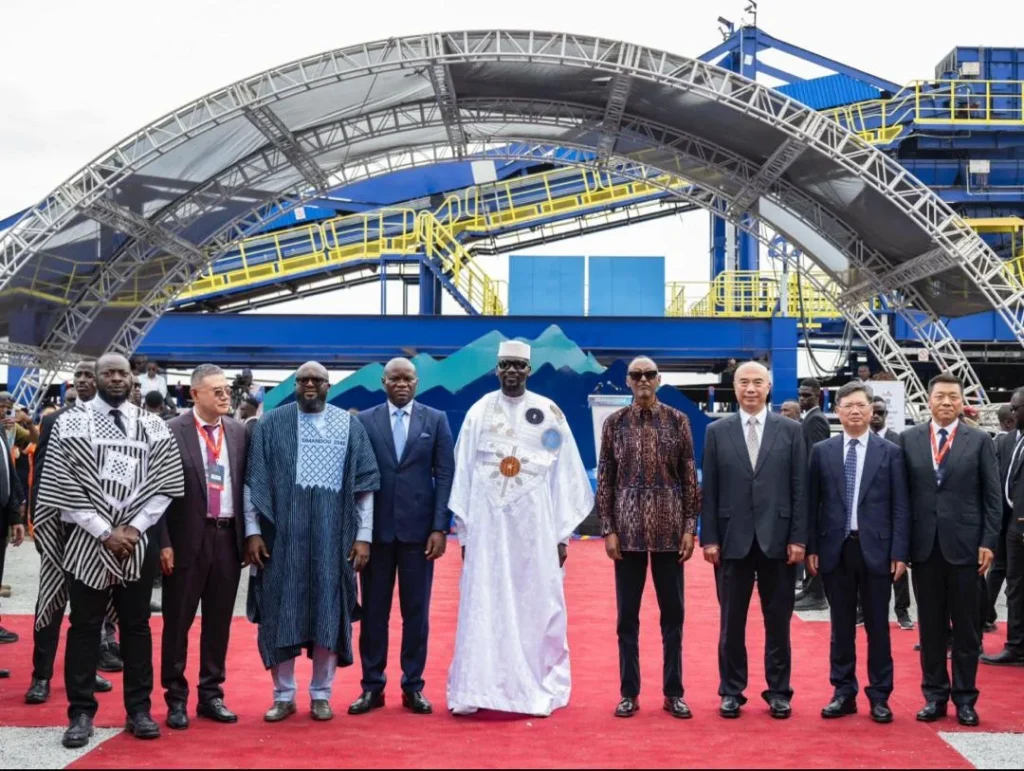
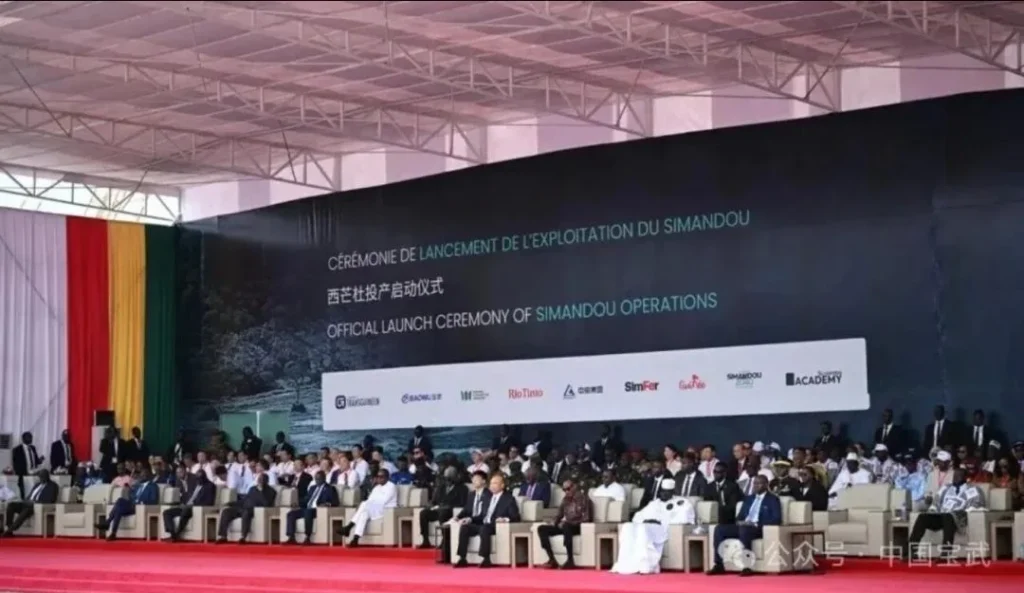
Conakry, In the heat and dust of Forécariah’s Atlantic coast, Guinea unveiled what may be the most significant mining moment in its modern history: on 11 November 2025, the long-awaited Simandou iron-ore project officially began startup operations.
It wasn’t just a mine opening it was the unveiling of a bold vision: a fully integrated, future-facing economic engine.
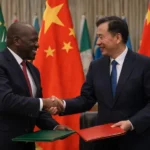
President Mamadi Doumbouya, flanked by visiting dignitaries such as Rwanda’s Paul Kagame and Gabon’s Brice Oligui Nguema, presided over the ceremony. But something else spoke just as loudly: China’s presence, embodied by Vice Premier Liu Guozhong, underlining just how central this project is to Beijing’s long-term resource and industrial strategy.
For Guinea, Simandou is the cornerstone of its “Simandou 2040” roadmap a grand plan to turn mineral wealth into economic sovereignty. As Djiba Diakité, Chief of Staff and head of that strategic committee, put it: “Simandou is more than a mining project: it is the driving force behind a national transformation.”
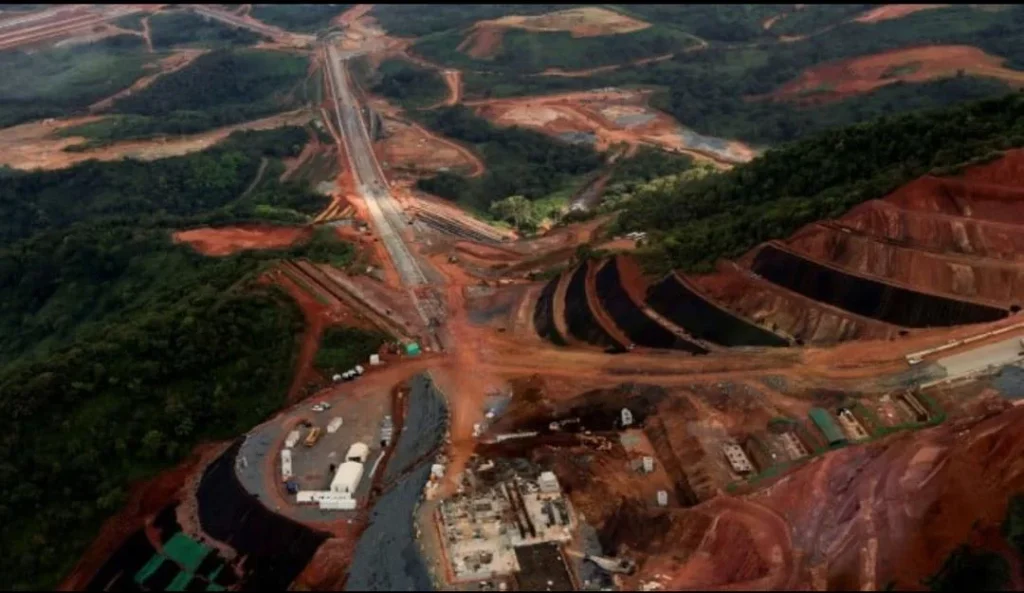
Behind the rhetoric lies a truly massive infrastructure commitment. Over 600 kilometres of trans-Guinean railway have been built, connecting the mines in the country’s southeast with a deep-water port in Forécariah infrastructure that, once fully tested and ramped-up, is expected to export up to 120 million tonnes of iron ore per year. The infrastructure will eventually be run by a Guinean-led company, the Compagnie du TransGuinéen (CTG), in which Guinea holds 15 %.
The ore itself is remarkable among the richest undeveloped iron-ore deposits in the world, with an average grade of around 65% iron, a quality highly prized in what is increasingly called “green steel” production.
That premium quality is central to Guinea’s strategy: Mines Minister Bouna Sylla has made no secret of his desire to command strong global prices, especially targeting markets in Europe and the Middle East, rather than simply relying on Chinese demand.
Still, China’s influence looms large: the project is roughly 75% Chinese-owned, through a mix of state-backed and commercial entities.
The involvement of Baowu, Chinalco, the Winning Consortium Simandou (WCS), and Rio Tinto (via its joint venture SimFer) reflects a complicated but mutually dependent relationship.
For China, access to Simandou’s high-grade ore is a strategic play especially as the nation’s steel industry looks to lower-emission production. At the launch, Hu Wangming, chairman of Baowu, emphasized the role this ore will play in supplying “low-carbon raw materials, for the development of China’s steel industry and the global steel sector.”
But Guinea is not passively handing over its riches. Leaders view Simandou as a lever to build more than just mines infrastructure, jobs, capacity. The government is already moving to accelerate domestic value-addition: there are plans to build alumina refineries and pellet plants, and feasibility studies are underway for more industrial processing of iron ore.
To make that possible, they’re looking at diverse energy sources hydropower, solar, even LNG because turning raw ore into more advanced products demands reliable power.
Still, the road ahead is not without risk. The spectre of corruption and governance challenges has long haunted Simandou, and there are environmental concerns tied to a railway cutting across rural Guinea, as well as questions about whether ordinary Guineans will see concrete benefits.
The Guinean Geological Laboratory, in fact, has warned that the state must maintain strong, independent capabilities “without strong labs the state risks being ‘deaf and mute’ in its own mining dealings,” one senior official said.
Yet for now, optimism was on full display. Rio Tinto’s CEO, Simon Trott, hailed the moment as an “outstanding achievement” part of a vision that connects scale, quality, and sustainability.
Guinea’s leaders, for their part, framed the launch not as an endpoint, but as the first chapter of a transformation: leveraging resource wealth to build roads, industries, and opportunity, not just for a selected few, but for a nation.
In a world where raw-material power often translates into geopolitical influence, Simandou is Guinea’s bold bet on the future and, in that gamble, it may well reshape not just its own destiny, but the global iron-ore market.