

By Cremilda Macuácua, China Africa News
JOHANNESBURG August 15, 2026 — For governments confronting unemployment, inequality, weak infrastructure and the pressures of a rapidly changing global economy, the challenge is rarely a shortage of ambitious development plans. The harder task is sustaining the institutions, political commitment and administrative capacity required to turn those plans into measurable improvements in people’s lives.
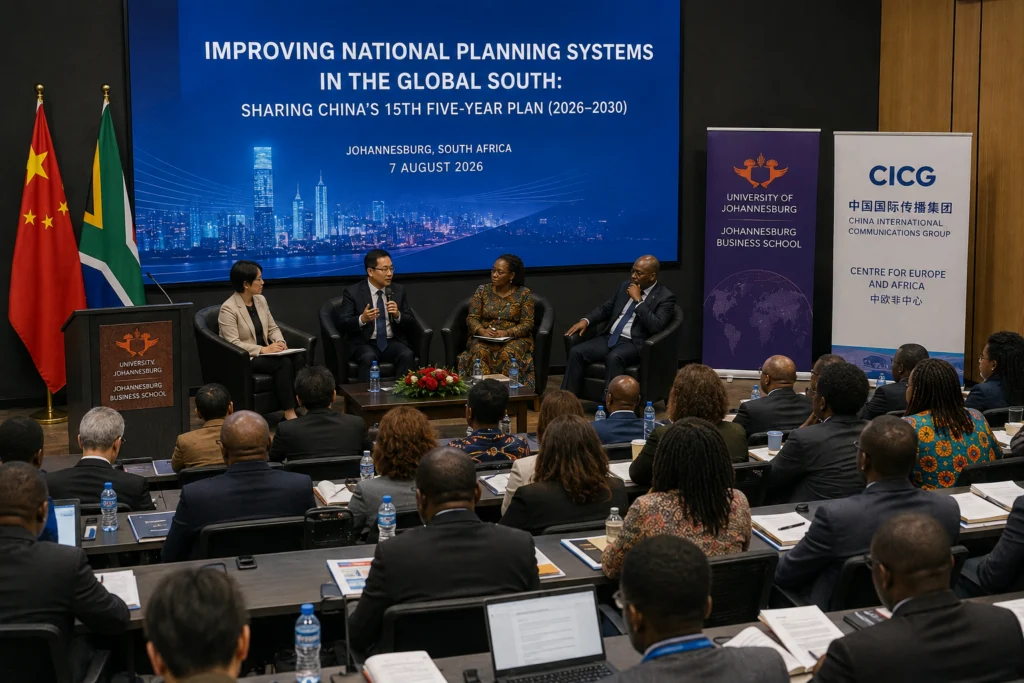
That question was at the heart of a high-level seminar in Johannesburg on Aug. 7, where Chinese and South African policymakers, academics and public-sector experts examined the role of long-term national planning in economic and social development.
Held at the Johannesburg Business School of the University of Johannesburg, the seminar, titled “Improving National Planning Systems in the Global South: Sharing China’s 15th Five-Year Plan (2026–2030),” brought together more than 100 participants from South Africa’s political, academic and media communities.
Organized by the China International Communications Group Centre for Europe and Africa and the Consulate General of China in Johannesburg, the gathering was framed as an exchange of development experience rather than a prescription for one country to replicate another’s political or economic system.
At the center of the discussion was China’s 15th Five-Year Plan, the latest phase of a planning tradition that has shaped the country’s economic transformation for more than seven decades.
Since the launch of China’s first Five-Year Plan in 1953, successive planning cycles have provided a framework for establishing national priorities, coordinating investment and aligning government institutions around long-term objectives. The system has evolved considerably over time, but its underlying emphasis on continuity and strategic coordination has remained a defining feature of China’s approach to development.
For many countries in the Global South, that experience raises a compelling question: Can long-term national planning provide the policy continuity necessary to overcome structural barriers to development?
Chinese Consul General in Johannesburg Pan Qingjiang argued that China’s development experience demonstrates the value of maintaining a long-term strategic orientation. Successive Five-Year Plans, he said, have played an important role in guiding China’s industrialization, economic modernization and broader social transformation.
But the Johannesburg discussion was not simply an examination of China’s achievements. It was also an assessment of what other developing countries might learn from the mechanisms behind them — and of what cannot be transferred from one national context to another.
South Africa provides an instructive case
The country has its own long-term development framework, the National Development Plan 2030, which seeks to eliminate poverty, reduce inequality and expand employment. Yet the gap between policy ambition and implementation remains one of the country’s most persistent governance challenges.
That is where the comparison with China becomes particularly relevant.
South Africa’s Deputy Minister of Public Service and Administration, Pinky Kekana, highlighted areas in which China’s experience could provide useful lessons, including strategic coordination, infrastructure development, industrial policy and long-term implementation.
At the same time, she emphasized the value of South Africa’s own institutional experience, particularly its constitutional framework, emphasis on accountability and system of cooperative governance.
The distinction is important.
The purpose of comparative development research is not necessarily to identify a single model and reproduce it elsewhere. Political institutions, economic structures, historical experiences and social conditions differ too substantially for straightforward transplantation.
The more productive approach is to identify principles that can be adapted to local circumstances.
In that respect, China’s experience with policy continuity and long-term coordination offers one possible area of study for South Africa and other developing economies.
Bandile Masuku, a member of the Gauteng Provincial Legislature, pointed to parallels between China’s 15th Five-Year Plan and South Africa’s National Development Plan 2030. Both, he noted, are ultimately concerned with improving living standards, strengthening economic development and addressing the needs of citizens.
Yet having comparable ambitions does not necessarily produce comparable results.
The decisive variable is implementation.
Zama Mthombeni, a University of Johannesburg scholar, underscored the importance of converting national objectives into practical outcomes in areas such as education, health care, employment and inequality.
That observation goes to the heart of the planning debate
A development strategy may articulate ambitious targets, but its effectiveness depends on the institutional machinery available to execute it. Effective planning requires capable public institutions, reliable data, policy coordination, adequate financing and mechanisms for monitoring performance and correcting course.
In other words, the quality of a national plan cannot be separated from the quality of the state responsible for implementing it.
This is one of the most consequential lessons emerging from the comparison between China and South Africa.
China’s planning system has benefited from a high degree of policy continuity and centralized coordination. South Africa operates within a constitutional democracy characterized by multiple spheres of government, political contestation and institutional checks and balances.
The two systems are therefore fundamentally different.
But differences do not make comparative learning impossible. On the contrary, they can make it more valuable.
South Africa can examine how China has coordinated infrastructure investment, industrial development and national priorities while considering which elements, if any, are compatible with its own constitutional and institutional environment.
Likewise, China’s engagement with African countries provides an opportunity for Chinese policymakers and scholars to understand the institutional realities, governance practices and development priorities of African states.
Such exchanges are particularly significant as the Global South seeks a greater role in shaping the international economic and political order.
The Johannesburg seminar reflected that broader trend. Its significance lay not simply in the presentation of China’s 15th Five-Year Plan, but in the attempt to place that plan within a wider conversation about how developing countries can strengthen their own national planning systems.
There is also a technological dimension to that conversation.
Kekana highlighted the growing importance of digital government, data-driven administration and emerging technologies, including artificial intelligence. For governments seeking to improve public services, technological modernization could offer new tools for managing resources, monitoring programmes and responding to citizens’ needs.
But technology alone cannot resolve institutional weaknesses
Digital systems can improve the efficiency of a capable administration, but they cannot substitute for political accountability, professional public institutions or effective leadership.
The same principle applies to national development plans.
A sophisticated document is not synonymous with a successful development strategy.
The durability of a national plan is ultimately measured by the state’s capacity to translate policy commitments into tangible socioeconomic outcomes.
For South Africa, that means confronting some of the country’s most persistent structural challenges: unemployment, inequality, inadequate infrastructure, uneven public-service delivery and constraints on economic growth.
For China, the challenge is different but equally significant: sustaining economic dynamism while navigating demographic change, technological competition, environmental pressures and an increasingly complex international environment.
The two countries therefore approach development from very different starting points.
Yet their shared membership in the Global South creates space for meaningful dialogue.
The Johannesburg seminar demonstrated that such dialogue need not be reduced to a contest between competing political models. It can instead focus on practical questions: How should governments establish long-term priorities? How can plans survive political cycles? What institutional arrangements improve implementation? How should governments measure progress? And how can developing countries learn from one another without abandoning their own political and social realities?
Across the Global South, governments are under pressure to deliver faster economic growth while addressing inequality, expanding employment, improving public services and investing in infrastructure. At the same time, they must contend with technological disruption, climate change and an international system undergoing profound economic and geopolitical shifts.
Under such circumstances, development planning is not merely a bureaucratic exercise.
It is a question of state capacity
China’s experience suggests that long-term planning can provide governments with a strategic framework for maintaining policy continuity and coordinating national priorities over extended periods. South Africa’s experience, meanwhile, illustrates the importance of constitutional accountability, institutional checks and public participation in determining how development strategies are designed and implemented.
Neither experience offers a universal template.
But together they provide a useful basis for a broader conversation about governance and development in the Global South.
The most important lesson may therefore be less about China’s Five-Year Plan itself than about the discipline of thinking beyond the immediate political cycle.
Development is rarely achieved through a single budget, administration or policy announcement. It is cumulative. Infrastructure built today affects productivity tomorrow. Investments in education shape the workforce years later. Industrial policies can take decades to produce their full effects.
That is why the question confronting governments is not simply whether they have a national development plan.
It is whether they possess the institutional capacity, political continuity and implementation discipline to make that plan matter.
For the countries of the Global South, the future of development planning may ultimately depend on precisely that distinction: not the ability to produce ambitious blueprints, but the ability to convert long-term national aspirations into lasting improvements in the lives of their citizens.