
By Senior Editor,China Africa News
Beijing, June 7, 2026 — As African nations intensify efforts to accelerate economic growth and improve living standards, China’s poverty reduction experience is increasingly attracting attention as a potential source of valuable lessons.
Over the past four decades, China achieved what many development experts consider one of the most significant social and economic transformations in modern history, lifting hundreds of millions of people out of extreme poverty. While Africa’s diverse political, economic, and social realities differ significantly from China’s, analysts argue that several elements of Beijing’s development strategy offer practical insights for the continent.
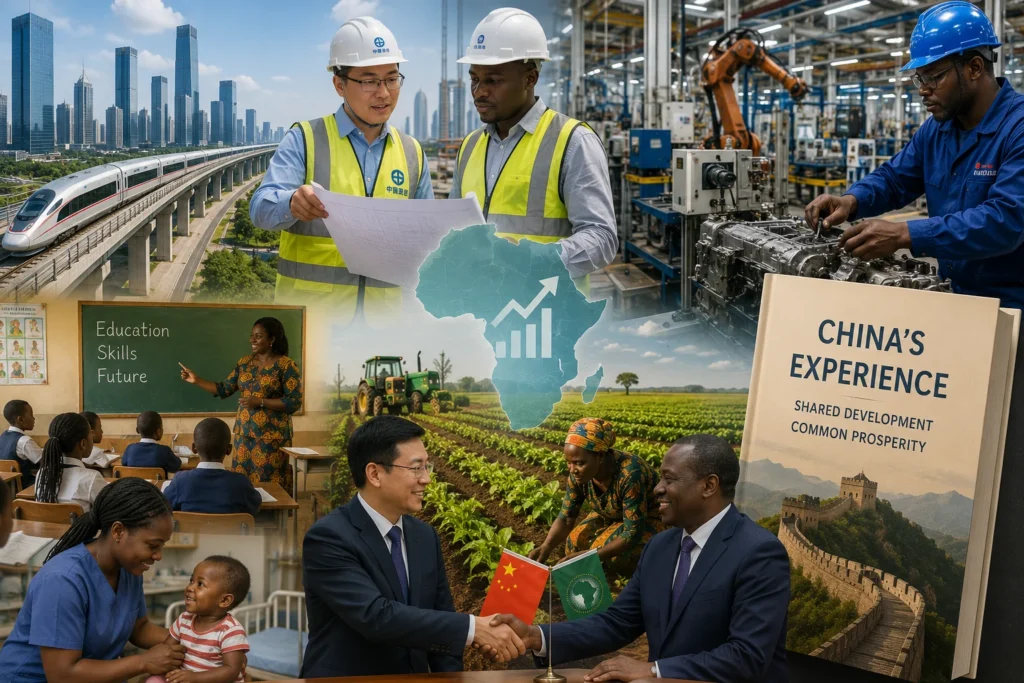
One of the most striking aspects of China’s success was its heavy investment in infrastructure. Extensive road networks, railways, electricity systems, and digital connectivity helped integrate rural communities into national and global markets. Improved infrastructure enabled farmers, entrepreneurs, and businesses to access new opportunities, stimulating economic activity and creating jobs.
Industrialization also played a central role in China’s transformation. By developing manufacturing capacity and expanding value-added industries, the country generated millions of employment opportunities that supported rising incomes and reduced poverty levels. For many African economies that continue to rely heavily on raw material exports, strengthening local industries could provide a pathway toward sustainable economic growth.
Another lesson lies in long-term development planning. China’s progress was driven by consistent national strategies implemented over many years. Rather than focusing solely on short-term gains, policymakers pursued broader economic and social objectives aimed at improving livelihoods and modernizing the economy. Experts suggest that similar policy continuity could help African countries achieve more durable development outcomes.
China’s approach to poverty reduction also extended beyond economic growth alone. Authorities implemented targeted interventions aimed at vulnerable populations, including investments in education, healthcare, skills development, and housing. These measures helped ensure that economic progress reached communities that might otherwise have been left behind.
Equally important was the emphasis on effective governance and implementation. Development policies were supported by strong administrative structures and mechanisms designed to track progress and address challenges. Many observers believe that strengthening institutional capacity remains essential for countries seeking to reduce poverty on a large scale.
However, development specialists caution against viewing China’s model as a blueprint that can be copied wholesale. Africa is home to more than 50 countries, each with unique political systems, demographic profiles, resource endowments, and development priorities. What worked in China may require significant adaptation to suit local realities.
The broader lesson is not replication but inspiration. Strategic infrastructure investment, support for productive industries, targeted social programs, and long-term policy commitment are principles that can be tailored to different national contexts.
As Africa continues its pursuit of inclusive growth, China’s experience demonstrates that large-scale poverty reduction is possible when economic transformation is matched by deliberate efforts to improve the lives of ordinary citizens. The challenge for African leaders will be identifying which lessons are most relevant and adapting them to meet the continent’s own development ambitions.