
By Senior Editor, China Africa News
NAIROBI, Kenya, July 2, 2026 — Kenya and China have moved to strengthen their long-standing partnership by expanding parliamentary cooperation on environmental protection, renewable energy and climate resilience, signaling a broader effort to align bilateral relations with the growing global focus on sustainable development.
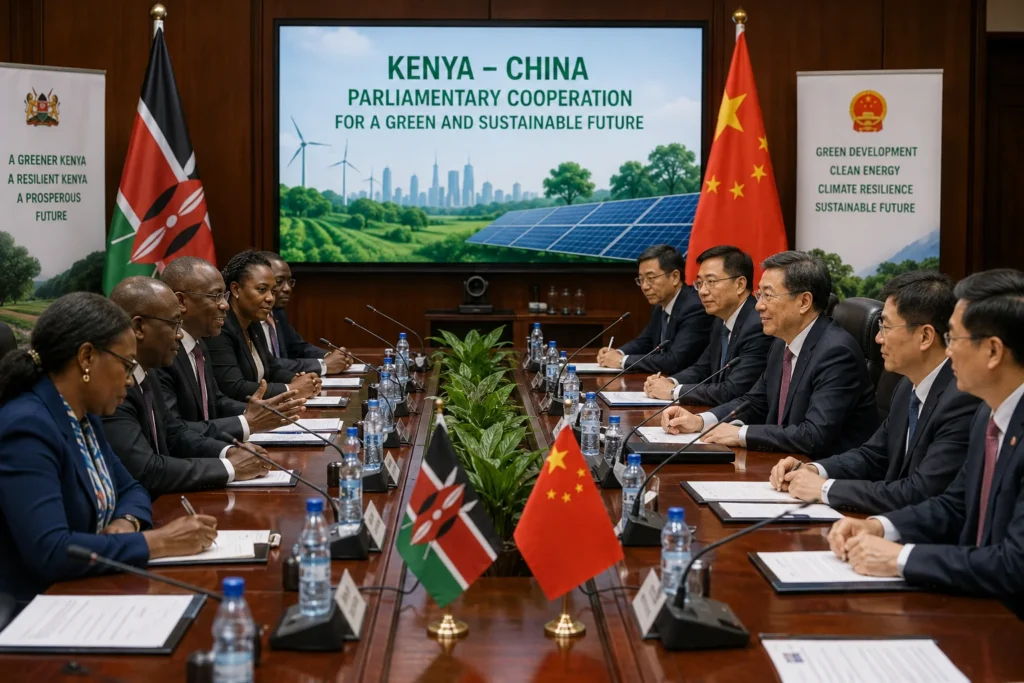
The discussions took place on Wednesday at Parliament Buildings in Nairobi, where members of Kenya’s National Assembly Departmental Committee on Environment, Forestry and Mining hosted a delegation from China’s National People’s Congress led by Lu Xinshe, Chairperson of the Environment and Resources Protection Committee of the Standing Committee of the 14th National People’s Congress. The meeting brought together legislators, parliamentary officials and diplomatic representatives to explore ways the two countries can work more closely on environmental legislation, green investment and clean energy policy.
While Kenya and China have traditionally been associated through infrastructure cooperation—ranging from transport networks to industrial development—the latest engagement reflects an evolution in the relationship. Environmental sustainability is increasingly becoming a central pillar of cooperation as both countries confront the economic and social consequences of climate change.
Kenyan lawmakers used the meeting to outline the country’s environmental priorities, pointing to recurring droughts, destructive flooding and mounting pressure on natural ecosystems. These challenges have intensified the need for policies that promote renewable energy, protect forests and encourage sustainable economic growth without compromising environmental resources.
Committee Chairperson Vincent Musyoka said the parliamentary dialogue offered an opportunity for both legislatures to exchange legislative experiences while strengthening oversight mechanisms that support environmental governance. Kenyan legislators also expressed interest in understanding China’s approach to mobilizing green financing, expanding rural electrification and integrating environmental safeguards into major infrastructure projects.
For Kenya, the discussions arrive at a critical moment. The government has committed to planting billions of trees over the coming decade as part of an ambitious campaign to restore degraded landscapes and increase forest cover. At the same time, the country continues to position itself as one of Africa’s leading producers of renewable electricity, drawing much of its power from geothermal resources while steadily expanding investments in wind and solar generation. Policymakers argue that achieving long-term economic growth will increasingly depend on balancing development with environmental stewardship.
Chinese representatives, meanwhile, emphasized the role of legislative institutions in translating environmental commitments into enforceable laws and effective oversight. Lu Xinshe said the historical friendship between China and Kenya provides a strong foundation for expanding cooperation in sustainable development, adding that environmental protection requires not only government action but also robust legal frameworks capable of guiding long-term policy implementation.
The meeting also underscored the increasingly strategic nature of parliamentary diplomacy. While executive governments typically negotiate trade agreements and investment deals, legislatures play an equally important role by shaping the legal and regulatory environments that determine how those agreements are implemented. Exchanges between parliamentary committees allow countries to compare legislative practices, share policy experiences and build institutional relationships that often outlast electoral cycles.
China has emerged as one of Kenya’s most significant economic partners over the past two decades, financing and constructing major transport, energy and industrial projects across the country. Although those investments have contributed to improved infrastructure and expanded economic opportunities, they have also generated debate over debt sustainability, environmental impacts and the need for greater local participation in development projects. Against that backdrop, cooperation focused specifically on environmental governance represents an effort to ensure future investments align more closely with sustainability objectives.
Kenya’s lawmakers also highlighted opportunities for technology transfer, particularly in renewable energy and low-carbon development. Expanding access to affordable clean energy remains a priority for rural communities where electricity availability can directly influence agricultural productivity, education outcomes and small business development.
The presence of senior diplomatic officials at the meeting further illustrated the importance both governments attach to parliamentary engagement. Chinese Ambassador to Kenya Guo Haiyan reaffirmed the embassy’s commitment to supporting continued exchanges between the two legislatures, describing parliamentary cooperation as an important bridge for strengthening broader bilateral relations.
Analysts say the discussions reflect a wider trend across Africa, where environmental policy is becoming increasingly intertwined with economic planning. As governments pursue industrial growth while responding to climate-related risks, partnerships that combine investment, legislative cooperation and technological exchange are expected to become more prominent.
Although no new bilateral agreements were announced during the Nairobi meeting, officials from both sides described the dialogue as laying the groundwork for deeper cooperation in environmental conservation, renewable energy development and climate resilience. The conversations are expected to continue through committee exchanges and future parliamentary engagements as Kenya and China seek to broaden a relationship that has expanded well beyond its traditional focus on infrastructure and trade.