

By Staff writer, China Africa News
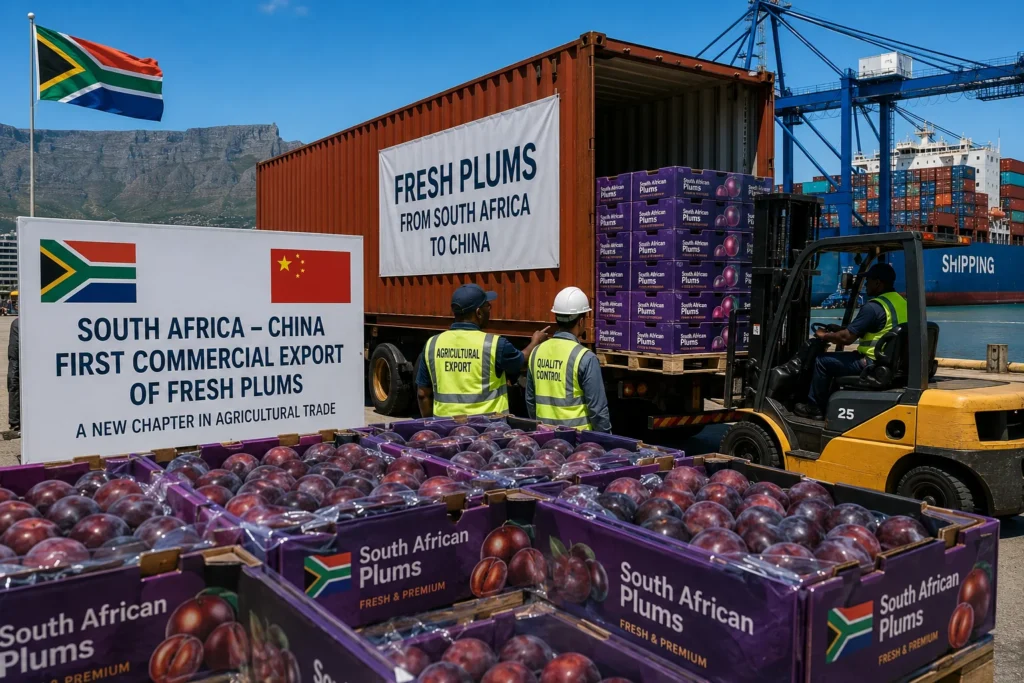
CAPE TOWN, South Africa, July 2, 2026 — South Africa has begun its first commercial exports of fresh plums to China under a newly implemented market access agreement, marking a significant milestone in agricultural trade between the two countries and offering fruit producers access to one of the world’s largest consumer markets.
The inaugural shipments, prepared at export facilities in the Western Cape before being transported through South Africa’s port network for delivery to China, represent the culmination of years of technical negotiations between agricultural authorities in Pretoria and Beijing. Industry officials say the development is expected to strengthen South Africa’s position as a leading exporter of premium deciduous fruits while creating new opportunities for growers seeking to diversify beyond traditional European markets.
For South Africa’s fruit industry, China has long been viewed as a strategic destination. Rising household incomes, urbanization and changing consumer preferences have fueled demand for imported fresh fruit, making the Chinese market increasingly attractive for exporters capable of meeting the country’s stringent phytosanitary and quality requirements.
Until now, South African plum producers had limited access to that market despite the country’s reputation as one of the Southern Hemisphere’s largest exporters of stone fruit. The implementation of the new export protocol removes a major commercial barrier and enables growers to begin supplying Chinese wholesalers and retailers during periods when domestic production is limited.
The first consignments consisted of approximately 20,000 cartons of fresh plums, according to industry reports, with exporters expecting volumes to increase over subsequent harvest seasons as more producers qualify under the agreed export standards. The shipments were carefully inspected, packed and certified in accordance with protocols developed jointly by South African and Chinese agricultural authorities to ensure compliance with China’s import regulations.
The breakthrough comes at a time when South Africa is actively seeking to expand agricultural exports into fast-growing Asian markets. While Europe remains the country’s largest destination for fresh fruit, producers have increasingly looked eastward to reduce dependence on traditional buyers and build resilience against fluctuating demand, changing trade policies and logistical disruptions.
Industry leaders say diversification has become an economic necessity. Expanding into new markets not only increases export earnings but also provides growers with greater flexibility during periods of oversupply in established destinations. Access to China’s vast consumer base is expected to strengthen the competitiveness of South African fruit producers in an increasingly crowded global marketplace.
The Western Cape, where most of South Africa’s deciduous fruit industry is concentrated, is likely to be the principal beneficiary of the new arrangement. The province accounts for the overwhelming majority of the country’s commercial plum production and has developed sophisticated packing, cold-chain and logistics infrastructure that enables exporters to maintain product quality during long-distance shipping.
Agricultural economists note that the agreement extends beyond plums alone. Successfully implementing one export protocol often creates momentum for expanding access to additional agricultural products, strengthening confidence between regulatory authorities and demonstrating the effectiveness of bilateral cooperation on food safety and plant health standards.
The development also reflects broader changes in economic relations between China and Africa. Over the past two decades, bilateral trade has expanded dramatically, driven largely by infrastructure investment and commodity exports. Increasingly, however, African governments are seeking to diversify that relationship by exporting higher-value agricultural goods, processed products and manufactured items capable of generating greater employment and income across local economies.
For South Africa, agriculture has become an increasingly important contributor to export earnings despite persistent challenges including drought, rising input costs, energy shortages and global shipping disruptions. Industry representatives argue that securing access to premium international markets is essential for sustaining investment, supporting rural employment and maintaining the competitiveness of the country’s farming sector.
Meeting China’s import requirements has required extensive collaboration between government agencies, scientific experts and producers. Export orchards must comply with detailed pest management protocols, traceability systems and food safety standards before fruit can be certified for shipment. Those requirements, while demanding, are widely regarded within the industry as necessary for maintaining consumer confidence and ensuring long-term access to overseas markets.
Trade analysts believe the success of the inaugural shipments will be closely monitored by exporters across the continent. Many African countries are seeking expanded access to Asian markets for agricultural products ranging from avocados and citrus fruits to coffee, cocoa and horticultural produce. Demonstrating that complex export protocols can be successfully implemented may encourage similar agreements elsewhere.
Officials from both South Africa and China have described the first shipments as more than a commercial transaction. They represent a practical example of deepening economic cooperation through agricultural trade, reflecting a broader effort to diversify bilateral relations beyond traditional sectors.
As the containers begin their journey from South African ports to Chinese distribution centers, growers are already looking toward future harvests with renewed optimism. If consumer demand develops as expected and export volumes continue to rise, the first shipment of South African plums to China may ultimately be remembered not simply as a successful export, but as the beginning of a new era in agricultural cooperation between Africa and Asia.