
By Senior Editor, China Africa News
NAIROBI, Kenya, July 2, 2026 — Kenyan and Chinese lawmakers on Wednesday pledged to deepen cooperation in green finance, environmental legislation and rural electrification, broadening a bilateral relationship that has increasingly shifted beyond infrastructure toward sustainable development and climate-focused policymaking.
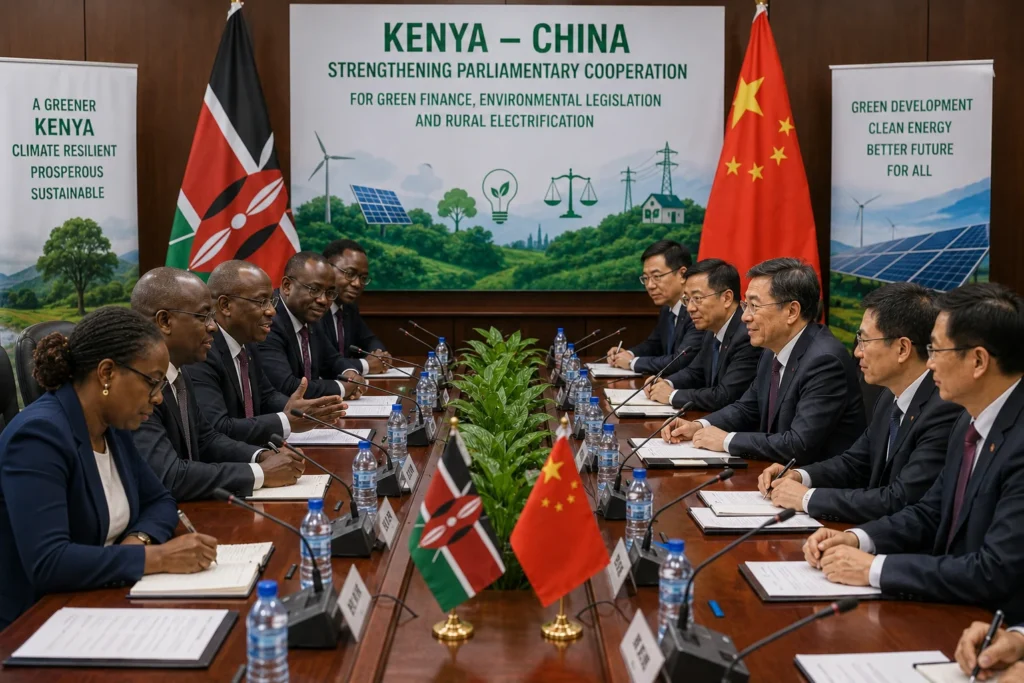
The discussions were held at Parliament Buildings in Nairobi during a meeting between members of Kenya’s National Assembly Departmental Committee on Environment, Forestry and Mining and a visiting delegation from China’s National People’s Congress. Led by Lu Xinshe, Chairperson of the Environment and Resources Protection Committee of the Standing Committee of the National People’s Congress, the Chinese delegation met Kenyan legislators to exchange experiences on environmental governance and explore opportunities for future collaboration.
The dialogue reflected a growing recognition by both governments that legislative institutions have a critical role to play in supporting the transition to low-carbon economies. While executive branches negotiate investment agreements and development projects, parliaments establish the legal frameworks that guide environmental standards, public spending and oversight of climate-related initiatives.
Among the central themes of the meeting was green finance, an area receiving increasing attention across Africa as governments seek to mobilize capital for renewable energy, climate adaptation and environmentally sustainable infrastructure. Kenyan lawmakers expressed interest in understanding how China has used financial policy to support large-scale investments in clean technologies while encouraging private sector participation in sustainable development.
For Kenya, expanding access to green financing is viewed as essential to achieving its climate commitments while maintaining economic growth. The country has positioned itself as one of Africa’s leaders in renewable energy, with geothermal power supplying a substantial share of national electricity generation. Officials say attracting additional climate investment will be necessary to strengthen energy security, improve resilience to increasingly severe weather events and support industrial development.
The discussions also focused on rural electrification, where both countries identified opportunities for cooperation in expanding electricity access to underserved communities. Reliable electricity remains a key driver of economic development, supporting agricultural productivity, healthcare delivery, education and small business growth in rural areas.
Kenyan legislators noted that while significant progress has been made in extending the national electricity grid, remote communities continue to face challenges related to infrastructure costs and energy affordability. They expressed interest in China’s experience deploying renewable energy technologies, including decentralized solar systems that can provide electricity to areas beyond conventional transmission networks.
Chinese representatives emphasized that environmental legislation and clean energy investment should advance together, arguing that strong legal institutions provide certainty for investors while ensuring development projects meet environmental standards. They highlighted China’s efforts to integrate ecological protection into national development planning and encouraged continued exchanges between parliamentary committees responsible for environmental policy.
The meeting formed part of a broader expansion of parliamentary diplomacy between Kenya and China. Although bilateral relations have historically centered on trade, transport infrastructure and investment, recent engagements have increasingly included cooperation on environmental governance, climate resilience and sustainable economic development.
Observers say the emphasis on legislative collaboration reflects an understanding that long-term development partnerships depend not only on financing and construction but also on effective governance. Environmental regulations, procurement standards and oversight mechanisms established by parliaments often determine whether development projects deliver lasting economic and social benefits.
Kenya’s lawmakers also underscored the importance of balancing economic growth with environmental conservation as the country continues to pursue industrialization. Climate change has intensified pressure on water resources, agriculture and biodiversity, making sustainable development an increasingly urgent policy priority.
Chinese officials welcomed Kenya’s efforts to strengthen environmental institutions and reaffirmed Beijing’s willingness to expand cooperation in areas including clean energy technology, environmental policy research and legislative capacity building. They described parliamentary exchanges as an important mechanism for sharing best practices and fostering mutual understanding between the two countries.
Although the meeting concluded without the signing of new agreements, officials from both delegations characterized the discussions as laying the foundation for deeper cooperation in green development. Future exchanges are expected to focus on legislative innovation, renewable energy policy and financing mechanisms capable of supporting climate-resilient growth.
As Kenya seeks to accelerate its transition toward a greener economy, policymakers increasingly view international partnerships not only as sources of investment but also as opportunities to strengthen the institutions that underpin sustainable development. Wednesday’s dialogue suggested that environmental governance is becoming an increasingly prominent dimension of the Kenya–China relationship, complementing decades of cooperation in trade and infrastructure