

By Cremilda Macuácua, China Africa News
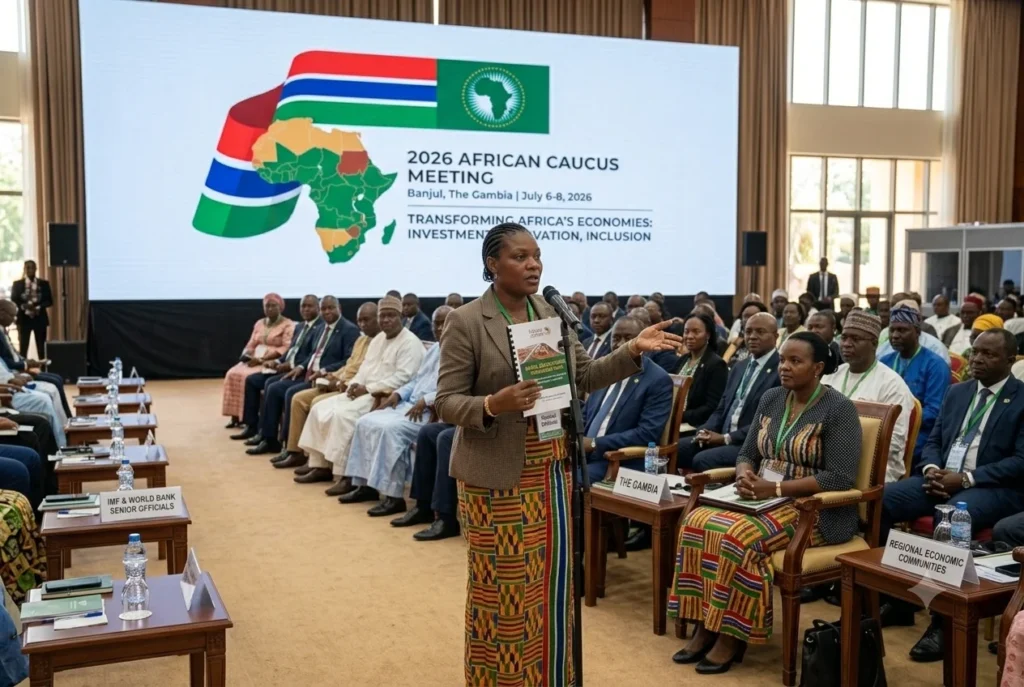
BANJUL, The Gambia, July 9, 2026 — African finance ministers and central bank governors have concluded the 2026 African Caucus Meeting with a unified call for sweeping reforms to the global financial system, increased investment in Africa’s development priorities, and stronger collaboration to address the continent’s mounting economic challenges.
Hosted by The Gambia from July 6 to 8, the annual gathering brought together representatives from 54 African member countries, alongside senior officials from the International Monetary Fund (IMF), the World Bank Group and other international financial institutions. The meeting serves as Africa’s principal platform for coordinating common positions before the IMF and World Bank Annual Meetings, where major decisions affecting global development finance are made.
This year’s discussions were held under the theme, “Transforming Africa’s Economies through Investment, Innovation and Inclusion,” reflecting growing recognition that the continent must accelerate structural reforms while securing greater international support to achieve sustainable growth.
Why the Meeting Was Held
The African Caucus was convened at a time when many African economies continue to grapple with multiple overlapping crises. Governments across the continent are facing rising public debt, elevated borrowing costs, inflationary pressures, currency depreciation, climate-related disasters and the lingering economic effects of global geopolitical tensions.
Finance ministers met to develop a coordinated African agenda aimed at strengthening the continent’s voice within international financial institutions. By presenting unified policy priorities, African countries hope to influence decisions on development financing, debt sustainability, climate funding and reforms to the global financial architecture.
Delegates emphasized that while Africa possesses abundant natural resources, a rapidly growing population and expanding digital economies, limited access to affordable financing continues to constrain economic transformation.
Key Resolutions
Among the meeting’s major outcomes was a renewed appeal for reform of the international financial system to better reflect the needs of developing economies. Ministers called for increased concessional financing, more equitable access to climate finance and stronger mechanisms to support countries facing debt distress.
The Caucus also underscored the importance of mobilizing private-sector investment to bridge Africa’s vast infrastructure financing gap. Delegates agreed that improving investment climates, strengthening governance and promoting regional integration would be essential to attracting long-term capital.
Innovation and digital transformation featured prominently throughout the discussions. Participants advocated greater investment in technology, digital financial services and innovation-driven industries as engines for job creation, productivity and economic diversification.
Another priority was expanding value addition within Africa by encouraging industrialization and reducing dependence on raw commodity exports. Ministers argued that processing natural resources locally would create employment, strengthen manufacturing and improve the continent’s position in global value chains.
The meeting further reaffirmed support for the African Continental Free Trade Area (AfCFTA), describing regional trade integration as a critical pathway toward economic resilience and sustainable development.
China’s Role in Africa’s Development Landscape
Although China did not participate in the African Caucus Meeting, its role in Africa’s development financing featured prominently in the broader context of discussions on investment, infrastructure and debt sustainability. Over the past two decades, China has emerged as one of Africa’s largest bilateral trading partners and a major source of infrastructure financing, supporting projects in transport, energy, telecommunications and industrial development across the continent.
As African governments seek diversified sources of development finance, many continue to view cooperation with China as an important complement to financing from multilateral institutions such as the IMF and the World Bank. Analysts say achieving Africa’s long-term development goals will require balanced partnerships that combine concessional lending, private investment and bilateral cooperation to close the continent’s infrastructure financing gap.
Challenges Facing Africa
Despite encouraging signs of economic recovery in several countries, delegates acknowledged that Africa continues to confront significant structural obstacles.
High debt-servicing costs are consuming increasing shares of national budgets, leaving governments with limited fiscal space to invest in healthcare, education and infrastructure. Climate change is intensifying droughts, floods and extreme weather events, placing additional strain on food security and economic productivity.
Many countries also face constrained access to affordable international financing due to high global interest rates, while geopolitical uncertainty continues to disrupt supply chains, investment flows and commodity markets.
Youth unemployment remains another pressing concern. With millions of young Africans entering the labour market each year, delegates stressed that sustained economic growth must translate into meaningful employment opportunities through industrial development, entrepreneurship and skills training.
A Unified African Voice
Host President Adama Barrow described the Caucus as an opportunity for African nations to strengthen collective action in pursuit of inclusive and sustainable development. He urged governments to harness the continent’s vast human and natural resources while deepening partnerships that promote investment, innovation and economic resilience.
As the meeting concluded, finance ministers reaffirmed their commitment to speaking with one voice on issues affecting Africa’s development, arguing that stronger cooperation will be essential to securing a more equitable global financial system capable of supporting the continent’s long-term aspirations.
The resolutions adopted in Banjul are expected to shape Africa’s collective engagement with the IMF and the World Bank in the months ahead, as governments seek greater financial support, fairer lending arrangements and increased investment to accelerate the continent’s economic transformation. Analysts note that the outcomes could also influence how African countries engage with key bilateral partners, including China, as they pursue sustainable financing, infrastructure development and long-term economic growth