
By Staff Writer, China Africa News
Editor’s note: This report is based on information first reported by The Times (UK) and incorporates additional background and analysis by China Africa News.
Beijing/Addis Ababa, 30 July, 2026 — Young Africans hold a more favorable view of China’s influence than that of the United States, according to the newly released 2026 African Youth Survey, reflecting Beijing’s expanding economic footprint across the continent and shifting perceptions among a generation shaped by infrastructure development, digital connectivity and employment concerns.
The survey found that 95 percent of respondents aged 18 to 24 viewed China’s influence positively, while 85 percent expressed positive views of the United States. The results suggest that although both countries enjoy broad support among Africa’s youth, China currently holds a stronger advantage in public perception.
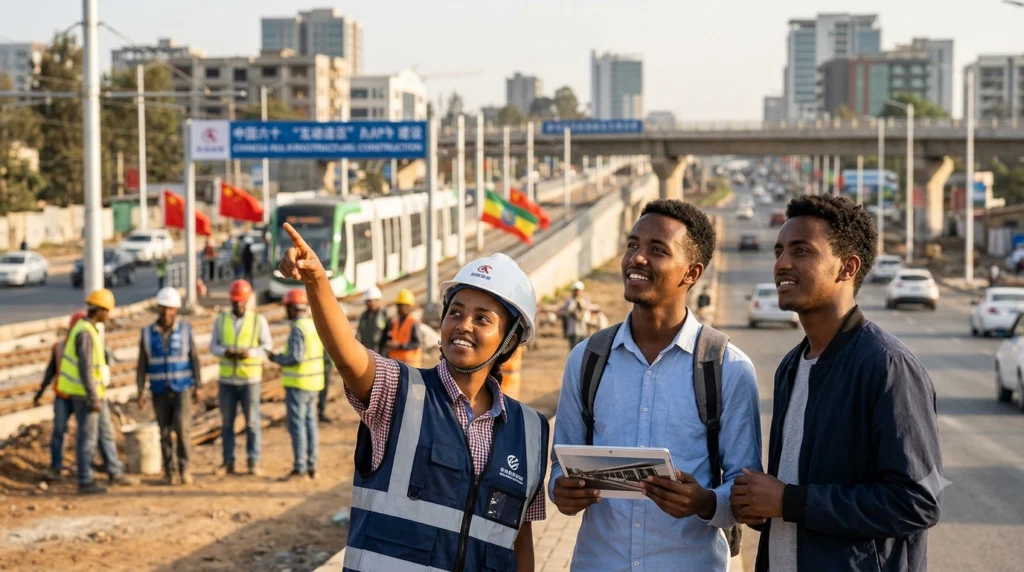
Researchers say the findings are closely tied to China’s visible investment strategy over the past two decades. Across Africa, Chinese companies have financed and built highways, railways, ports, airports, power plants and telecommunications networks. Many of these projects are tangible and easily recognized by local communities, reinforcing the perception that China’s engagement delivers immediate economic benefits.
China has also become Africa’s largest bilateral trading partner, with trade expanding steadily over the past decade. Manufacturing investments, industrial parks and special economic zones established with Chinese support have contributed to job creation in several countries, particularly in sectors such as construction, logistics and light manufacturing.
Education has also played a role. Thousands of African students have received scholarships to study at Chinese universities, while vocational training initiatives and technology partnerships have increased opportunities for skills development. Analysts say these programs have strengthened people-to-people ties and fostered a more favorable image of China among younger generations.
By contrast, although the United States remains a significant investor and development partner, many of its contributions are concentrated in areas such as health care, humanitarian assistance, governance and security cooperation. Experts note that while these programs have delivered substantial long-term benefits including support for disease prevention, education and democratic institutions they are often less visible than major infrastructure projects that directly transform cities and transportation networks.
Economic opportunity appears to be a decisive factor for many respondents. With youth unemployment remaining one of Africa’s most pressing challenges, investments that create jobs and improve transport and energy infrastructure are often viewed as having an immediate impact on daily life.
Despite the overwhelmingly positive perceptions of China, researchers caution that favorable public opinion does not eliminate concerns surrounding some Chinese-backed projects. Questions persist over debt sustainability, transparency in financing agreements, environmental impacts and the participation of local businesses and workers. Several African governments have sought to renegotiate loan terms or increase local content requirements to maximize domestic economic benefits.
The survey nevertheless indicates that Africa’s younger generation increasingly evaluates international partnerships through practical outcomes rather than geopolitical alignment. Access to employment, reliable infrastructure, education and economic opportunity appears to weigh more heavily than ideological considerations.
As global competition for influence in Africa intensifies, the findings underscore a broader reality: young Africans are placing greater value on partnerships they believe deliver measurable improvements to their lives. Whether that perception changes will likely depend on how both China and the United States adapt their engagement with a continent expected to account for one-quarter of the world’s population by 2050.