
By Staff Writer
Paris, France August 14, 2026 — For years, the Democratic Republic of Congo’s eastern provinces have been trapped in a cycle of armed rebellion, regional mistrust and fragile diplomatic promises. Now, a new agreement involving one of the region’s most notorious armed groups is putting those promises to a practical test.
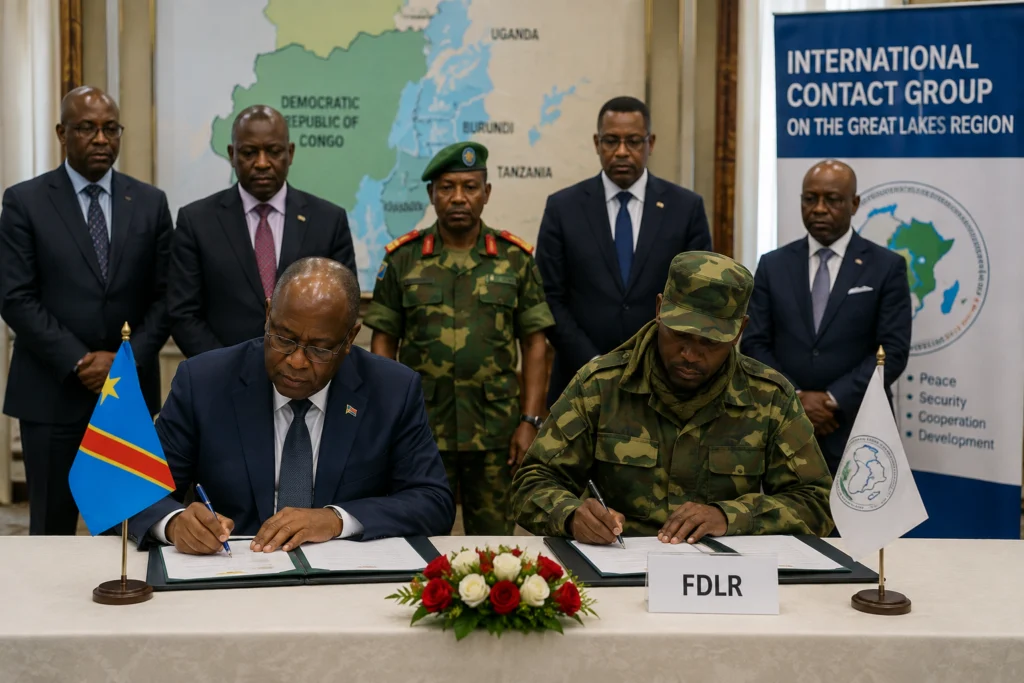
On July 28, the Congolese government announced that a faction of the Democratic Forces for the Liberation of Rwanda, or FDLR, had formally accepted and signed a protocol for disarmament, demobilization and cantonment. The move was immediately welcomed by the International Contact Group for the Great Lakes, a coalition of countries and institutions seeking to support the region’s peace process.
But the group’s message was less a declaration of victory than a warning: signing an agreement is not the same as implementing it.
The International Contact Group, chaired by France and including the United States, Belgium, Canada, Denmark, the European Union, Germany, the Netherlands, Sweden, Switzerland and Britain, called on the Congolese authorities to move quickly from paper to action. It urged Kinshasa to establish an operational plan and a credible timetable for effectively neutralizing the FDLR, in accordance with commitments made in the Washington agreements and related military arrangements.
That demand comes at a particularly sensitive moment
The FDLR has long been at the center of Rwanda’s security concerns in eastern Congo. Rwanda has repeatedly argued that armed groups linked to the organization pose a threat to its territory, while Kinshasa’s relations with Kigali have deteriorated amid the broader conflict involving the AFC/M23 alliance and other armed actors.
For the peace process to hold, the Contact Group said, the FDLR cannot remain a military or political instrument for anyone.
It made that point unusually bluntly: any “colocation or operational collaboration” between Congolese forces and elements of the FDLR would contradict commitments made under the Washington accords.
The warning reflects one of the central dilemmas of the conflict. Peace negotiations have produced increasingly detailed commitments, but implementation on the ground remains difficult. Armed groups continue to operate, governments continue to accuse one another of violating agreements, and civilians remain caught between competing military and political agendas.
The Contact Group therefore pressed Kinshasa to clarify how the agreement will address impunity and to work with the United Nations peacekeeping mission, MONUSCO, as a key partner in carrying it out.
At the same time, the group stopped short of placing the entire burden on Congo. It said it was prepared to welcome concrete steps by either Congo or Rwanda in fulfillment of commitments made through the broader peace process.
That distinction matters
The Washington agreements and the Doha Framework are not simply bilateral arrangements. They form part of a much wider diplomatic effort involving African and international mediators, including the African Union. The Contact Group urged all parties to continue implementing the commitments they have already made rather than allowing negotiations to become an endless cycle of announcements.
There is also a more immediate concern: the civilians living amid the conflict.
The Contact Group reminded all parties of their obligations under international humanitarian law and called for respect for United Nations Security Council resolutions 2773 and 2808, including the sovereignty and territorial integrity of states. It also demanded immediate de-escalation and full, safe and unhindered humanitarian access.
One development offered a rare sign of momentum
The group described a prisoner-exchange agreement between the Congolese government and AFC/M23 as an important confidence-building measure. It specifically welcomed a recent transfer facilitated by the International Committee of the Red Cross, in which people released by Congolese authorities were transferred to AFC/M23.
Such steps may appear modest beside the scale of the conflict. But in a war sustained in part by mistrust, even limited acts of cooperation can carry diplomatic weight.
The challenge now is whether those small openings can be connected into something larger.
The FDLR disarmament protocol offers one such opportunity. If implemented transparently and credibly, it could address a longstanding source of Rwanda’s security concerns while strengthening the broader peace process. If it remains largely symbolic, however, it risks becoming another document in a long archive of agreements that failed to change realities on the ground.
That is why the Contact Group’s statement is significant.
It does not present the July 28 signing as the end of a conflict. It presents it as the beginning of a test — one in which Congo, Rwanda, AFC/M23 and the other parties to the peace process will be judged not by what they sign, but by what they do next.
In eastern Congo, where diplomacy has often moved faster on paper than on the battlefield, implementation may be the hardest promise of all. And this time, the world is watching for results.