
By staff writer, China Africa News
Kigali, Sept 28, 2026 What began 55 years ago as a diplomatic relationship between Rwanda and China has grown into something far broader a partnership woven into trade, education, infrastructure, finance and business?
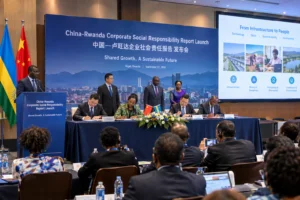
The scale of that transformation was on display in Kigali last week as the two countries marked 55 years of diplomatic relations. The occasion offered more than a reflection on past ties; it highlighted how deeply the relationship has become embedded in Rwanda’s economic and development ambitions.
Rwanda and China have moved well beyond traditional diplomatic engagement. The two countries upgraded their relationship to a Comprehensive Strategic Partnership in 2024, reflecting the expanding scope of their cooperation.
For Rwanda, that cooperation has increasingly been measured not only through government agreements, but through the movement of students, experts, goods, capital and technology between the two countries.
Chinese Ambassador Gao Wenqi highlighted the growing people-to-people dimension of the relationship. In 2026, about 150 Rwandan students reportedly travelled to China on degree scholarships, while more than 300 Rwandan experts participated in training programmes and workshops.
But perhaps one of the clearest signs of how far the relationship has travelled can be found in a place less visible than a diplomatic reception: Rwanda’s banking system.
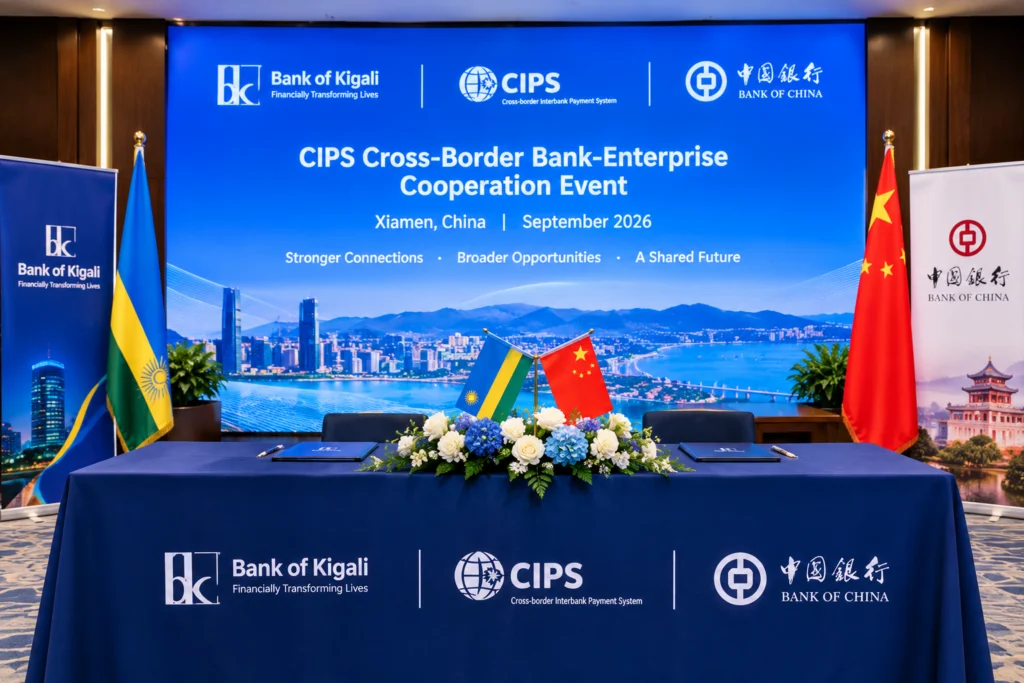
In September, Bank of Kigali became the first bank in Rwanda and the first bank headquartered in East and Central Africa to become a direct participant in China’s Cross-Border Interbank Payment System, or CIPS.
The agreement was signed in Xiamen, China, during the second CIPS Cross-Border Bank-Enterprise Cooperation Event.
At first glance, the development may appear to be a technical banking story. In reality, it offers a glimpse into the increasingly sophisticated economic links between Rwanda and China.
CIPS provides clearing and settlement services for cross-border transactions conducted in China’s renminbi. For Bank of Kigali, direct participation means that some payments between Rwandan and Chinese businesses can move through a more direct channel, potentially reducing the number of intermediaries involved.
It does not replace SWIFT, the global financial messaging network. Rather, the two systems can work alongside each other, with CIPS providing a direct connection to China’s renminbi settlement infrastructure.
For businesses trading between the two countries, that distinction matters
China has become Rwanda’s largest trading partner, and the numbers illustrate the scale of the relationship. Trade between the two countries reached approximately $1.76 billion in 2024, after rising sharply between 2021 and 2024.
The relationship continued to deepen in 2026. Data from Rwanda’s National Institute of Statistics cited that China accounted for 26.7 percent of Rwanda’s imports in the first quarter of the year, worth about $355.5 million.
China also accounted for 25.8 percent of Rwanda’s domestic exports during the same period, valued at nearly $95 million.
Those figures represent a relationship that is no longer confined to state-to-state cooperation. They represent thousands of commercial transactions Rwandan businesses buying from Chinese suppliers and Rwandan producers seeking access to Chinese consumers.
Rwanda exports coffee, tea, chili, minerals and other products to China, while Chinese goods make up a significant portion of Rwanda’s imports.
The financial connection provided by CIPS could make that trade easier to manage. A Rwandan importer dealing with a Chinese supplier could have a more direct route for settling payments in renminbi. For exporters, the system could likewise facilitate payments from Chinese buyers.
The significance, therefore, extends beyond Bank of Kigali itself
It represents another layer of connectivity between the two economies at a time when Rwanda is seeking to expand trade, attract investment and increase the value of what it exports.
China’s decision to remove tariffs on imports from least-developed countries, including Rwanda, has also created additional opportunities for Rwandan products to enter the Chinese market.
Yet the Rwanda-China relationship cannot be reduced to trade figures and financial systems.
At the 55th-anniversary celebration in Kigali, a drawing featuring a Chinese panda and Rwanda’s mountain gorilla, created by Rwandan student Aline Ingabire, offered a more symbolic representation of the ties between the two countries.
Behind the symbolism are practical exchanges: students travelling to China, experts receiving training, businesses importing and exporting, and financial institutions building direct connections with the Chinese market.
That is perhaps the most significant change in the relationship over the past 55 years.
The partnership has moved from diplomacy into the systems that underpin economic activity.
The Bank of Kigali’s entry into CIPS is a particularly telling example. It may be a development in the banking sector, but it also reflects the wider direction of Rwanda-China relations from diplomatic friendship towards deeper economic and institutional integration.
As the two countries look beyond their 55th anniversary, the challenge will be to translate these growing connections into greater opportunities for Rwandan businesses, stronger exports and broader economic benefits.
For now, one thing is clear: the Rwanda-China relationship is no longer simply about what governments say to each other. It is increasingly about how people, businesses, money, knowledge and opportunities move between the two countries.