
By Cremilda Macuácua, China Africa News
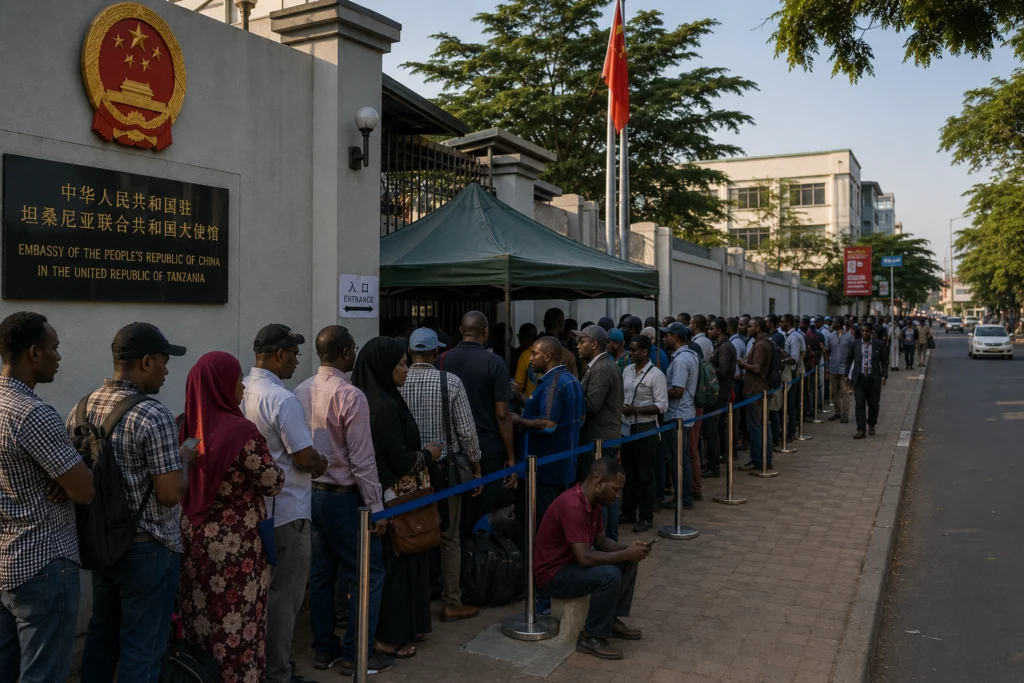
DAR ES SALAAM, Tanzania, August 12,2026 — Before dawn, the queue outside China’s diplomatic mission in Dar es Salaam has become an unlikely measure of the depth of Tanzania’s commercial relationship with Beijing.
Applicants seeking Chinese visas have reported spending long hours, and in some cases days, trying to submit their documents. Some have arrived well before the embassy opens, while others have had to make repeated trips as they navigate the application process.
The congestion has created difficulties for Tanzanian traders whose businesses depend on regular trips to China to source merchandise. Delays can mean additional travel expenses, postponed purchases and changes to business plans.
On Wednesday, the Chinese Embassy in Tanzania responded publicly to the concerns, saying that Tanzanian citizens were not facing any new policy barrier to obtaining Chinese visas. Instead, the embassy attributed the pressure to a significant increase in applications, which it said had placed additional demands on its processing capacity.
The embassy said it was working to expand its capacity and improve the efficiency and quality of visa services. It advised applicants to begin their applications at least three weeks before their intended departure and to monitor the application system for requests for additional documents or revisions.
The issue is revealing partly because neither side has described it as a diplomatic dispute.
Instead, it appears to be a practical challenge emerging from the growing volume of movement between two countries whose economic relationship has expanded significantly over the years.
For Tanzania, China has become deeply embedded in everyday commerce. Chinese goods make up a substantial share of Tanzania’s imports, and many Tanzanian traders travel to China to purchase products directly from manufacturers and wholesalers.
That means the visa process has become an important link in a much larger commercial chain.
The complaints surfaced publicly on Aug. 3, when Khamisi Abdallah Livembe, chairman of the Tanzania Traders Association, raised concerns about difficulties at a government-private-sector meeting focused on the implementation of Tanzania’s Development Vision 2050.
The concerns have also prompted discussion among some traders about how Tanzania’s changing business environment could affect those who travel abroad to source goods. The Chinese Embassy, however, has said there is no policy preventing Tanzanian applicants from obtaining Chinese visas.
The embassy’s explanation is straightforward: there are simply more applications
Its official visa information says that the growing number of applicants and the increased volume of applications have prompted the embassy to strengthen its processing capacity. It has also advised applicants to avoid relying on unofficial intermediaries and instead use the embassy’s official channels for visa information.
The episode illustrates a broader feature of Tanzania’s relationship with China.
As trade grows, so does the importance of the everyday systems that allow people to move between the two countries. A Tanzanian trader traveling to China to meet suppliers is one small part of a much larger network linking Chinese manufacturers and businesses with consumers across East Africa.
A delay at a visa office may therefore seem like a minor administrative matter, but for an individual trader it can affect an entire business trip from flights and accommodation to meetings with suppliers and the arrival of new merchandise.
The Chinese Embassy has described the increase in applications as a sign of growing exchanges between China and Tanzania and said it welcomes stronger people-to-people ties.
For the traders waiting in Dar es Salaam, however, the issue remains immediate and practical: obtaining a visa in time to travel.
As the embassy works to respond to the increased demand, the queues outside its gates have become a quiet illustration of Tanzania’s increasingly active commercial relationship with China.
The relationship is measured not only in trade figures and investment agreements, but also in the growing number of ordinary Tanzanians who need to travel between the two countries to keep their businesses moving.