

By staff writer
Addis Ababa, October 22, 2026 — China and Africa are seeking to deepen their economic partnership through expanded trade, financial cooperation and initiatives under the Forum on China–Africa Cooperation (FOCAC), as the growing use of China’s yuan offers new opportunities to make cross-border transactions more efficient.
Established in 2000, FOCAC has become a central platform for coordinating China–Africa cooperation, bringing together China, African countries and the African Union to advance trade, investment, infrastructure development and broader development priorities. Its 2025–2027 Beijing Action Plan provides a framework for continuing this engagement.
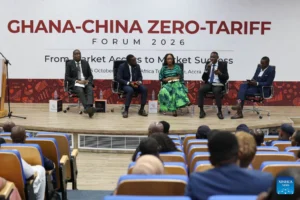
The latest developments in trade settlement point to a growing financial dimension in this relationship. China’s implementation of zero-tariff treatment for 53 African countries with which it maintains diplomatic relations, effective May 2026, is creating additional opportunities for African exporters to access the Chinese market.
Yuan settlement gains ground
African banks are increasingly building the infrastructure needed to settle transactions directly in renminbi (RMB), commonly known as the yuan. Ecobank Group has signed a memorandum of understanding with China’s Cross-Border Interbank Payment System (CIPS), while Stanbic Bank has expanded its connection to the system across several African markets.
Rwanda’s Bank of Kigali also announced in September that it had become a direct CIPS participant, highlighting the growing relevance of yuan-based payments in East Africa.
These developments could reduce the need for businesses to convert local currencies into US dollars before making payments to Chinese suppliers. Fewer intermediary transactions may lower some banking costs, shorten settlement times and reduce exposure to exchange-rate movements between currencies.
For African exporters, receiving yuan payments could also provide an alternative way to manage earnings from sales to China. This may become increasingly relevant as trade expands in agricultural products, minerals and manufactured goods.
Strengthening cooperation through FOCAC
The growing use of the yuan complements FOCAC’s broader objective of strengthening economic links between China and African countries. Trade between the two sides reached approximately $348 billion in 2025, an increase of 17.7 per cent from the previous year, according to figures reported by Xinhua.
More accessible payment channels could help smaller businesses participate in this growth, provided banks offer affordable services and practical guidance. Combined with improved market access, investment and trade facilitation, currency cooperation could support a more connected China–Africa commercial relationship.
However, wider yuan adoption is not without challenges. African currencies can fluctuate against the yuan, and businesses may face difficulties using or converting yuan earnings where financial markets remain limited. The US dollar is also likely to remain important in international trade.
For the partnership to deliver broad benefits, governments and financial institutions will need to strengthen financial literacy, improve access to payment infrastructure and ensure that smaller enterprises are not excluded.
As China and Africa continue to advance cooperation through FOCAC,the yuan offers an additional instrument for supporting trade and financial connectivity. Its long-term contribution will depend not simply on greater usage, but on whether the resulting efficiencies translate into stronger African exports, more competitive businesses and mutually beneficial economic growth.