
By staff writter, China Africa News
NAIROBI, Kenya August 18,2026 — For years, Kenya’s economic relationship with China has been defined, in large part, by what Kenya buys: machinery, manufactured goods, technology and other products from one of the world’s largest industrial economies.
Now, Kenyan officials are hoping to change the direction of that relationship.
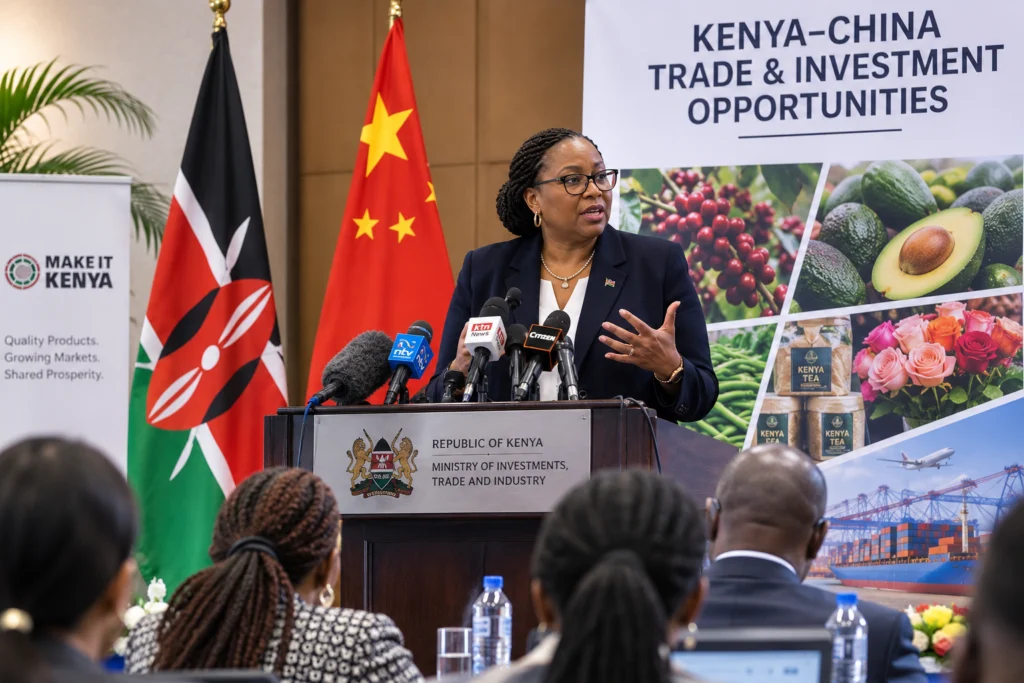
China’s decision to provide zero-tariff access for goods from African countries with diplomatic relations with Beijing is creating a new opportunity for Kenya to expand its exports, according to Regina Ombam, Kenya’s principal secretary for trade.
But Ms. Ombam says the opportunity is about more than simply selling more Kenyan products in China. The larger ambition is to use access to the Chinese market to push Kenyan businesses toward higher-value production, industrialization and greater competitiveness.
“We got into the Early Harvest arrangement” with the zero-tariff policy taking effect May 1, Ms. Ombam said in an interview with Xinhua published Monday. “Our big thinking was around how do we make Kenya competitive?”
A market of enormous scale
That question goes to the heart of one of Kenya’s longstanding economic challenges.
The country has a diversified economy and is one of East Africa’s major commercial centers, but much of its export earnings still depend on agricultural commodities. Tea, coffee, horticultural products and other agricultural goods are important sources of foreign exchange, while the country continues to seek ways to expand manufacturing and move further up global supply chains.
China’s new tariff policy could make that transition easier — but only if Kenyan producers can meet the demands of Chinese consumers.
China is one of the world’s largest consumer markets, and its rapidly changing food culture is creating openings for African agricultural exporters.
Ms. Ombam pointed specifically to Kenyan tea, avocados and fresh vegetables as products with growing potential in China. She also pointed to increasing Chinese interest in organic and “farm-to-table” food.
For Kenyan producers, eliminating tariffs can make their goods more competitive by reducing the costs associated with entering the Chinese market.
But tariff-free access does not automatically translate into successful exports.
Kenyan companies must still produce goods in sufficient quantities, meet Chinese quality and food-safety requirements, establish reliable supply chains and understand the preferences of Chinese consumers. For agricultural exporters, maintaining quality from the farm to the Chinese customer can be just as important as the tariff charged at the border.
That is why Ms. Ombam sees the policy as something larger than a conventional trade concession.
Kenya, she said, wants to use the Chinese market to demonstrate the quality of its products and to present the country as a competitive supplier rather than simply a source of raw materials.
From commodities to higher-value exports
The more consequential part of Kenya’s strategy may lie beyond agriculture.
For decades, African economies have faced a familiar problem: exporting commodities while importing finished products made from those same resources. The arrangement can generate export revenue, but much of the higher-value economic activity — processing, manufacturing, packaging and technology — takes place elsewhere.
Kenyan officials increasingly want to change that equation.
Ms. Ombam said cooperation with China is already contributing to technology transfer and the development of industrial parks. The objective, she said, is to encourage businesses to think in terms of exports and industry rather than dependence on raw materials.
That could mean processing agricultural products before they leave Kenya, developing manufacturing capacity and creating businesses capable of serving not only China but other international markets.
The distinction is important
Selling unprocessed agricultural commodities can generate income for farmers and exporters. Processing those commodities domestically can create additional jobs in manufacturing, packaging, logistics and services while allowing Kenyan companies to capture a larger share of the final value.
China’s experience is one reason Kenyan officials see the partnership as potentially useful. Over several decades, China transformed itself from a predominantly agricultural economy into a manufacturing powerhouse, building industrial capacity and export networks on a scale few other countries have matched.
Kenya is not China, and its economic circumstances are very different. But Kenyan policymakers see lessons in China’s emphasis on manufacturing, efficiency and practical technology.
The opportunity and the challenge
The shift also reflects a broader evolution in Kenya-China economic relations.
Chinese companies and institutions have played a significant role in Kenya’s infrastructure development and in sectors ranging from construction and transport to technology and manufacturing. The new emphasis on market access gives the relationship another dimension: China is increasingly being viewed not only as a source of investment and imports, but also as a destination for African products.
Ms. Ombam described China as a partner that can help Kenya grow, pointing to what she characterized as China’s practical approach to innovation and its focus on solutions suited to local circumstances.
There is also a strategic calculation behind Kenya’s interest.
Kenya is positioning itself as a gateway to the wider African market. Its membership in the East African Community, the Common Market for Eastern and Southern Africa and the African Continental Free Trade Area gives companies operating in Kenya potential access to markets beyond the country’s borders.
That means an investor looking at Kenya may not be interested only in selling to Kenya’s roughly 50 million consumers. The larger attraction is the possibility of using Kenya as a base for reaching customers across East and, potentially, much of the African continent.
China’s tariff policy could therefore have effects beyond the immediate Kenya-China trade relationship.
Yet there is a fundamental problem that the new policy alone cannot solve.
China and Africa have developed an enormous trading relationship, but the flow of goods has historically been heavily weighted toward Chinese exports. African countries have often struggled to sell enough goods to China to balance what they import.
Tariff-free access addresses one barrier. It does not solve the deeper question of whether African economies have enough products, processing capacity and industrial infrastructure to compete at scale.
For Kenya, that means the test will not be how many products receive zero tariffs on paper. It will be whether Kenyan companies actually use the opportunity.
If Kenyan tea exporters can expand their presence in Chinese supermarkets and restaurants, if avocado and vegetable producers can reliably supply Chinese consumers, and if manufacturers can begin exporting more sophisticated products, the policy could help change the composition of Kenya’s trade with China.
If exports remain concentrated in a handful of commodities, the effect could be considerably smaller.
The zero-tariff arrangement therefore presents Kenya with both an opportunity and a challenge.
The opportunity is access to one of the world’s largest markets without the burden of import tariffs on qualifying goods. The challenge is building an economy capable of taking advantage of that access.
That means improving productivity, investing in processing facilities, developing reliable logistics, meeting international standards and helping local companies scale.
It also means making sure that the benefits extend beyond large exporters.
For farmers, manufacturers and smaller businesses, access to a new market matters only if they can afford to enter it and remain competitive once they do.
Kenya’s success may ultimately depend on whether the Chinese market becomes a destination not just for Kenyan commodities but for Kenyan brands, processed foods and manufactured goods.
That is the more ambitious vision behind Ms. Ombam’s comments.
The goal is not simply to send more Kenyan products to China.
It is to use China as a demanding global market — and as a source of investment, technology and industrial experience — to encourage Kenya to produce more of what the world wants to buy.
The zero tariff removes one obstacle.
What Kenya does with the opening will determine whether it becomes a meaningful shift in the country’s economic relationship with China, or simply another preferential trade arrangement that leaves the underlying structure of commerce largely unchanged.
For a country seeking to move from exporting what it grows to exporting what it makes, that distinction could prove decisive.