
By staff writer, China Africa News
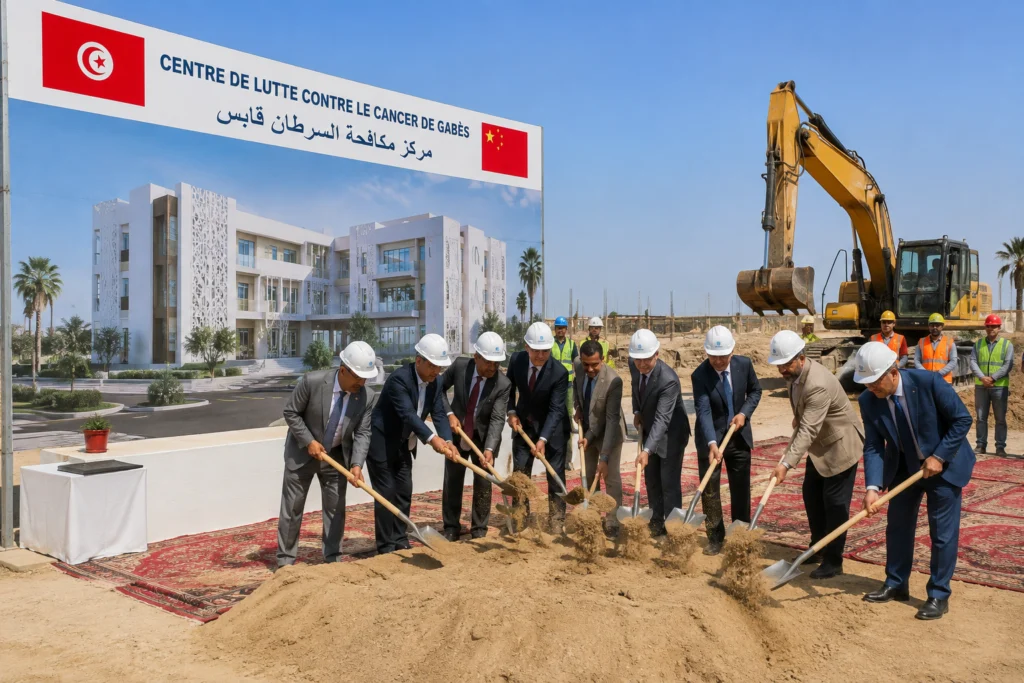
GABÈS, Tunisia, August 24, 2026 — A new chapter in Tunisia’s efforts to expand access to specialized cancer care began Sunday in the southeastern city of Gabès, where construction was launched on a cancer treatment center backed by China.
The project, covering roughly 4,000 square meters, is intended to strengthen medical services in a region where patients have often faced the burden of traveling considerable distances for specialized treatment.
Once completed, the facility will bring together a day hospital, a radiotherapy unit, a pathology laboratory and other supporting services under one roof. The center represents another step in the expanding health-care cooperation between Tunisia and China, while also addressing a pressing domestic need: improving access to cancer diagnosis and treatment beyond the country’s principal urban centers.
Walid Naija, director general of health at Tunisia’s Ministry of Health, said the facility would help make high-quality cancer treatment and care more accessible to residents of southeastern Tunisia. For patients and their families, the significance of the project extends beyond the construction of a new medical facility.
Cancer treatment frequently requires repeated consultations, diagnostic examinations and radiation sessions, making proximity to specialized services an important consideration for patients living far from major medical centers. The project is also being presented by both countries as part of a broader framework of pragmatic cooperation. Liang Gang, counselor in charge of economic and commercial affairs at the Chinese Embassy in Tunisia, said the initiative reflected the continuing development of bilateral ties.
With its planned combination of radiotherapy, pathology and day-treatment services, the center is expected to provide a more integrated approach to cancer care in Gabès and surrounding areas. For southeastern Tunisia, the project therefore carries a significance that is both practical and symbolic: practical because it promises to bring specialized treatment closer to communities that need it, and symbolic because it illustrates how international cooperation can be translated into infrastructure with a direct bearing on everyday life.
The launch marks the beginning of that process. The more consequential measure of its success, however, will come when the center opens its doors to patients and begins turning the promise of improved regional cancer care into reality.