
By staff writer, China Africa News
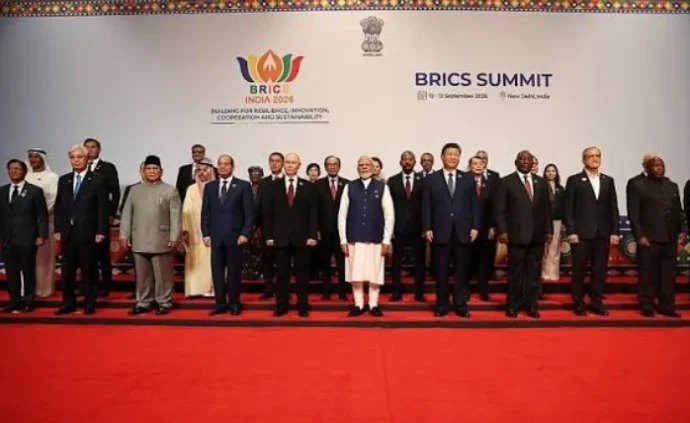
NEW DELHI, Sept. 14,2026 — China is seeking to push the expanded BRICS grouping toward deeper technological and economic cooperation, with President Xi Jinping unveiling a package of initiatives centered on artificial intelligence, digital industries, trade and investment at the bloc’s summit in New Delhi on Sunday.
The proposals including a BRICS artificial-intelligence open-source community, a partnership among special economic zones and a new forum on trade in services represent an effort by Beijing to translate the growing political weight of BRICS into practical economic cooperation.
For South Africa, the only African member of the original BRICS grouping, the proposals come at a particularly significant moment. President Cyril Ramaphosa used the same summit to argue that developing countries need greater access to technology, finance and skills while warning that artificial intelligence must be governed in ways that protect societies and support development.
The convergence of the two positions points to one of the increasingly important questions for Africa: whether the continent can become more than a consumer of technologies developed elsewhere and instead participate in the development, ownership and industrial application of the next generation of digital technologies.
From political grouping to economic platform
Speaking during the second session of the 18th BRICS Summit, Xi argued that the expanded grouping should use its links with emerging markets and the wider Global South to strengthen industrial and supply-chain cooperation.
He proposed five initiatives.
The first would establish a BRICS AI open-source community, with China offering cooperation on the development and application of large language models, as well as training and other forms of technical exchange.
The second focuses on trade and investment. China proposed a BRICS special economic zone partnership designed to improve policy coordination and investment access. Beijing also said it would host a BRICS Forum on Trade in Services next year.
The remaining proposals target digital industries, intelligent manufacturing and the development of scientific and engineering talent. China said it would support a BRICS digital ecosystem platform, smart-factory cooperation and an engineering alliance aimed at developing skills and creating common competency standards.
Taken together, the proposals suggest that Beijing wants BRICS to become more deeply connected to the real economy not simply a forum for political statements.
Why Africa matters
The significance for Africa extends beyond South Africa’s membership.
The expanded BRICS grouping now includes Egypt and Ethiopia, alongside South Africa, giving Africa three full members in the bloc. Several other African countries are also part of the wider BRICS partner-country network.
That gives African countries an opportunity to influence discussions over the rules governing technologies, investment and trade in the Global South.
But it also exposes a central challenge.
African economies have historically exported large quantities of raw materials while importing higher-value manufactured goods and technologies. Xi’s emphasis on smart manufacturing, digital infrastructure and industrial supply chains therefore speaks directly to the continent’s longstanding ambition to move further up the value chain.
Ramaphosa made that point explicitly at the summit, arguing that mineral beneficiation should take place at source and that Africa needs greater access to technologies, finance and capacity to build resilient economies. He also called for investment in sovereign AI capabilities in developing countries.
For South Africa, the overlap is notable. Beijing is offering a framework built around technology, manufacturing and economic integration; Pretoria is calling for those same capabilities to be deployed in ways that support industrialisation and development.
The AI question
Artificial intelligence may ultimately prove to be the most consequential part of the new agenda.
China’s proposal for an open-source BRICS AI community comes as countries across the Global South are trying to avoid becoming permanently dependent on a small number of companies and countries for advanced computing, software and AI systems.
An open-source approach could potentially lower barriers to participation by allowing researchers, companies and governments to collaborate on models and applications rather than relying exclusively on proprietary systems.
But access alone will not solve the problem.
Countries also need computing infrastructure, electricity, data, skilled engineers, research institutions and regulatory capacity. Those requirements are particularly important for African economies, where digital transformation is advancing rapidly but infrastructure and skills gaps remain substantial.
Ramaphosa called for BRICS to establish an international mechanism for independent scientific evaluation of AI, alongside stronger safeguards, incident reporting and investment in AI capabilities in developing economies.
That places an important qualification on China’s proposal: the future of AI cooperation in the Global South will not be determined only by who develops the technology, but also by who sets the rules governing it.
A changing global economic map
The initiatives also reflect a broader transformation within BRICS.
The group has expanded well beyond its original five members, bringing together major emerging economies from Asia, Africa and the Middle East. Its members differ sharply in political systems, economic structures and foreign-policy priorities, making deep integration difficult.
Yet the sheer size and diversity of the grouping give it an increasingly important role in debates over trade, technology, finance and global governance.
China appears to be betting that practical cooperation can provide the glue.
Rather than attempting to create a single BRICS market or common currency overnight, the proposals announced in New Delhi focus on narrower areas where cooperation may be easier to build: digital platforms, industrial partnerships, special economic zones, services trade and technical training.
For Africa, that could be significant.
If such initiatives translate into factories, technology-transfer programmes, engineering training and higher-value processing of African resources, BRICS could become a useful instrument for industrial development.
If they remain primarily political declarations, their impact will be considerably smaller.
The next test
The real test will therefore come after the summit.
China has put forward an ambitious agenda. South Africa has signalled that it wants technology and economic cooperation to serve inclusive development rather than deepen existing inequalities.
The question now is whether those priorities can be converted into projects that African economies can participate in on meaningful terms.
For a continent seeking to industrialise,digitise and capture more value from its resources, the answer could determine whether the next phase of China-Africa economic relations is defined primarily by trade in commodities or by a deeper partnership in technology, manufacturing and innovation.
Xi’s proposals in New Delhi do not answer that question.
But they suggest that AI, digital industries and industrial cooperation are likely to become increasingly important battlegrounds in the next chapter of China’s engagement with Africa and the wider Global South