
By Senior Editor, China Africa News
BEIJING, August 23,2026 — China and African countries are seeking to deepen cooperation in media and audiovisual production, with artificial intelligence, digital technology and joint storytelling emerging as central pillars of the relationship.
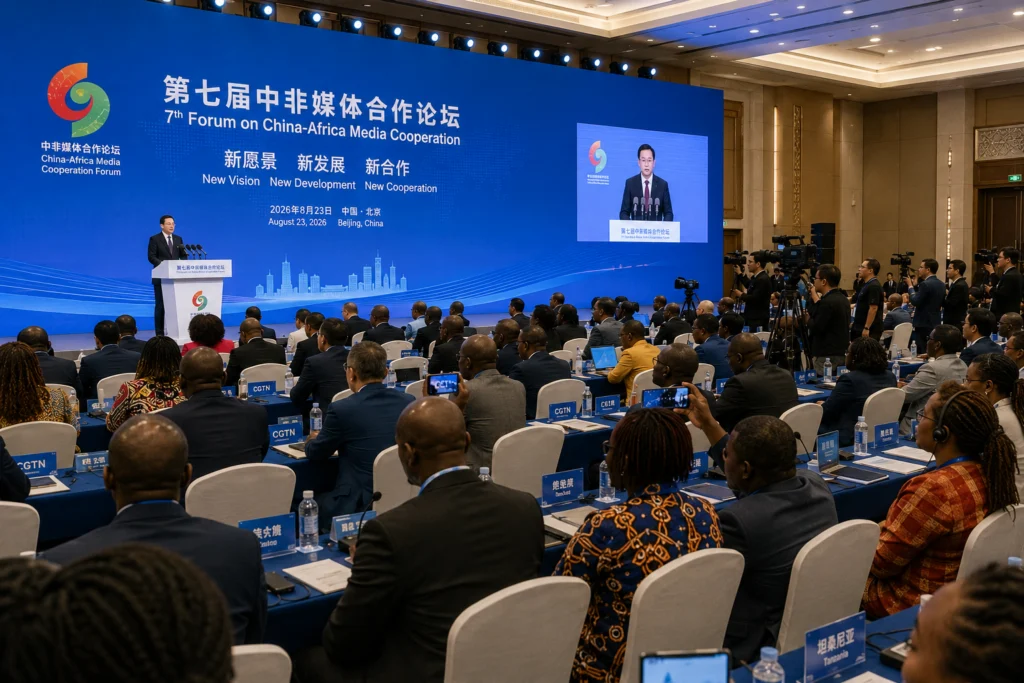
The shift was on display this week in Beijing, where the 7th Forum on China-Africa Media Cooperation brought together about 400 representatives from China and 45 African countries. The participants included government officials, broadcasters, media executives, diplomats, academics and representatives of international organizations.
The forum adopted a joint declaration calling for closer cooperation in news reporting, content production, audiovisual media and youth exchanges. Participants also discussed how artificial intelligence could transform broadcasting and content creation, while emphasizing the importance of responsible governance of the technology.
The gathering comes at a moment when media industries across Africa are being reshaped by streaming platforms, social media, mobile technology and the rapid emergence of artificial intelligence. For African media organizations, the challenge is increasingly not simply access to technology, but the ability to use it to produce, distribute and monetize African stories.
That concern was reflected in calls from African officials for the relationship with China to move beyond the traditional exchange of programs and technical assistance toward more ambitious forms of cooperation, including joint production and two-way storytelling.
Alhaji Mohamed Sarjoh Bah, the African Union’s permanent representative to China, said Africa should not remain merely a recipient of information. He argued that African institutions should play a greater role in producing and distributing knowledge and ideas about the continent.
The objective, he said, should extend beyond exchanging television programs to building partnerships in film, broadcasting, animation, gaming and digital media — industries capable of creating jobs, attracting investment and developing new creative markets.
The emphasis on storytelling reflects a broader debate about how Africa is represented internationally. For decades, African officials and cultural leaders have argued that the continent’s image has too often been shaped by outsiders.
Ahunna Eziakonwa, the United Nations undersecretary-general and special adviser on Africa, told the forum in a video address that storytelling could be an important instrument of development. She pointed to a growing generation of African creators using streaming services, animation and digital platforms to present different perspectives on the continent.
Artificial intelligence is adding another dimension to that transformation
Gregoire Ndjaka, director-general of the African Union of Broadcasting, said African media organizations needed to master AI and apply it to their own development needs. Other participants highlighted its potential to overcome language barriers, expand access to information and allow producers to distribute content across multiple platforms.
But the enthusiasm was accompanied by caution. Participants also raised questions about regulation, governance and the risks associated with the use of AI in media. The discussions suggested that cooperation between China and African countries could increasingly involve not only technology transfer but also the development of approaches to managing the technology.
For Sierra Leone, for example, the priority is not simply to import Chinese technology but to participate in developing systems that reflect African realities.
The forum also produced concrete projects. Eighty audiovisual cooperation initiatives were unveiled, covering joint productions, content exchanges and emerging formats such as short-form dramas. Chinese and African broadcasters are also continuing reciprocal programming, giving audiences in both regions greater access to one another’s television and audiovisual content.
The scale of existing cooperation is substantial. Chinese officials said that more than 80 Chinese productions had been broadcast in Africa over the past two years, while more than 80 programs from 29 African countries had been shown on major Chinese television channels and streaming platforms. The two sides have also developed joint audiovisual productions.
Training is another important part of the partnership. African media professionals have participated in programs in China and across Africa, including training focused on emerging technologies and the use of artificial intelligence in content production.
The forum’s focus on young people reflects the same reality. Much of the continent’s digital media growth is being driven by a young population that increasingly consumes news and entertainment through smartphones and social platforms rather than traditional television and newspapers.
In that environment, media cooperation is becoming about more than broadcasting. It is increasingly connected to technology, education, employment, culture and trade.
The stakes are significant. China and Africa together represent nearly three billion people, and the ability to circulate stories, cultural products and information between those markets could shape how each side understands the other.
For African media organizations, deeper cooperation with China could provide access to technology, training, production expertise and new distribution networks. For China, stronger ties with African broadcasters and creators provide an opportunity to expand the reach of Chinese content while building closer cultural connections across the continent.
The question now is whether the next phase of cooperation will produce a genuinely two-way media relationship — one in which African stories reach Chinese audiences with the same consistency that Chinese stories reach Africa.
The Beijing forum offered an ambitious answer: joint production, shared technology and a greater role for young creators.
The future of China-Africa media cooperation, participants suggested, will not be defined simply by who has the technology to tell a story. It will increasingly be defined by who gets to tell the story, whose perspective is heard and how effectively the two sides can tell it together.