
By Cremilda Macuácua, China Africa News
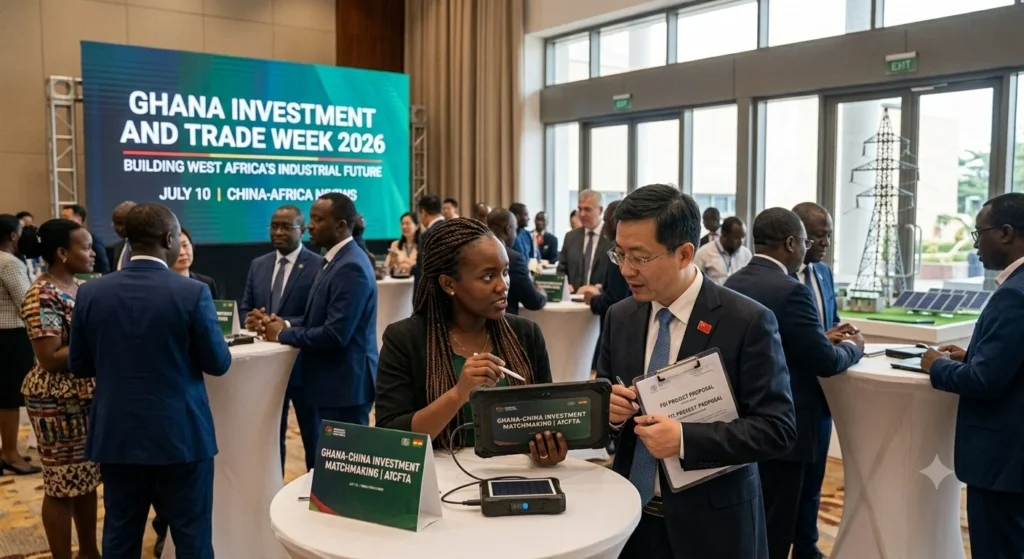
Accra, July 10,2026 — Chinese companies are increasingly positioning Ghana as a strategic destination for expansion into West Africa, using the Ghana Investment and Trade Week (GITW) as a platform to identify new investment opportunities, forge partnerships, and deepen commercial ties with local businesses. The event, held in Accra, brought together investors, policymakers, manufacturers and entrepreneurs from across the globe with a shared objective of accelerating cross-border trade and foreign direct investment (FDI).
Far from being a conventional trade exhibition, GITW has evolved into a strategic business forum where investment discussions are linked directly to sectors considered critical to Ghana’s long-term economic transformation. These include manufacturing, renewable energy, infrastructure, construction, technology, logistics and industrial development—all industries in which Chinese firms have established significant expertise over the past two decades.
The participation of Chinese businesses reflects a broader trend in China-Ghana economic relations. Ghana has increasingly become an attractive investment destination due to its political stability, expanding consumer market, strategic Atlantic coastline and its role as a gateway to the African Continental Free Trade Area (AfCFTA), which offers businesses access to a market of more than one billion consumers across Africa.
For many Chinese enterprises, the attraction extends beyond Ghana’s domestic market. Establishing operations in Ghana allows companies to position themselves closer to emerging regional supply chains while benefiting from improving infrastructure, free zone incentives and growing industrial policies designed to encourage value addition rather than raw commodity exports. This makes the country an increasingly competitive manufacturing and distribution hub for West Africa.
Business matchmaking sessions formed one of the central features of the investment week, enabling Chinese investors to engage directly with Ghanaian companies, government agencies and potential local partners. Such interactions are particularly significant because successful foreign investment in Ghana increasingly depends on partnerships that combine international capital with local knowledge, regulatory understanding and market access.
Analysts note that Chinese investment in Ghana has historically focused on infrastructure, construction and manufacturing, but recent developments suggest a gradual diversification into renewable energy, digital technologies, logistics and industrial innovation. This shift aligns with Ghana’s ambition to modernize its economy while attracting investments capable of generating employment, technology transfer and industrial growth.
The event also underscored Ghana’s efforts to strengthen its position as a preferred destination for international investors. Organisers highlighted the country’s commitment to facilitating business through policy dialogue, investment promotion and stronger collaboration between government and the private sector. Discussions throughout the summit centred on improving competitiveness, expanding infrastructure financing and encouraging sustainable industrialisation.
While the growing presence of Chinese businesses presents considerable opportunities, experts argue that the long-term success of such investments will depend on ensuring that projects create meaningful local value. This includes increasing local employment, strengthening supply chains involving Ghanaian enterprises, promoting skills development and encouraging technology transfer rather than limiting investments to import-driven commercial activities.
Ultimately, the strong participation of Chinese businesses at Ghana Investment and Trade Week signals continued confidence in Ghana’s economic potential. As global companies seek stable entry points into African markets, Ghana is increasingly positioning itself not only as an attractive investment destination but also as a strategic commercial gateway capable of connecting international capital with the continent’s expanding economic opportunities.