
By staff writer
KIGALI, Rwanda | November 24, 2026
When Ishimwe Amon crossed into the Democratic Republic of the Congo (DRC) in search of work, he expected to earn a living through his skills in electrical installation and metal welding. Instead, his time in Bukavu ended in detention after Congolese soldiers accused him of being a Rwandan spy.
Amon says he spent several days locked in a basement before an intervention by International Alert, working with its teams in Rwanda and the DRC, helped secure his release.
“They arrested me, accusing me of being a Rwandan commando. They locked me up in a basement, where I spent many days,” he recalled. “Later, the International Alert team in the DRC, working together with their counterparts in Rwanda, intervened and managed to convince the soldiers to release me.”
His experience reflects some of the justice-related vulnerabilities facing communities along the Rwanda-DRC border, where cross-border movement, limited legal information and difficulties accessing justice can leave people exposed.

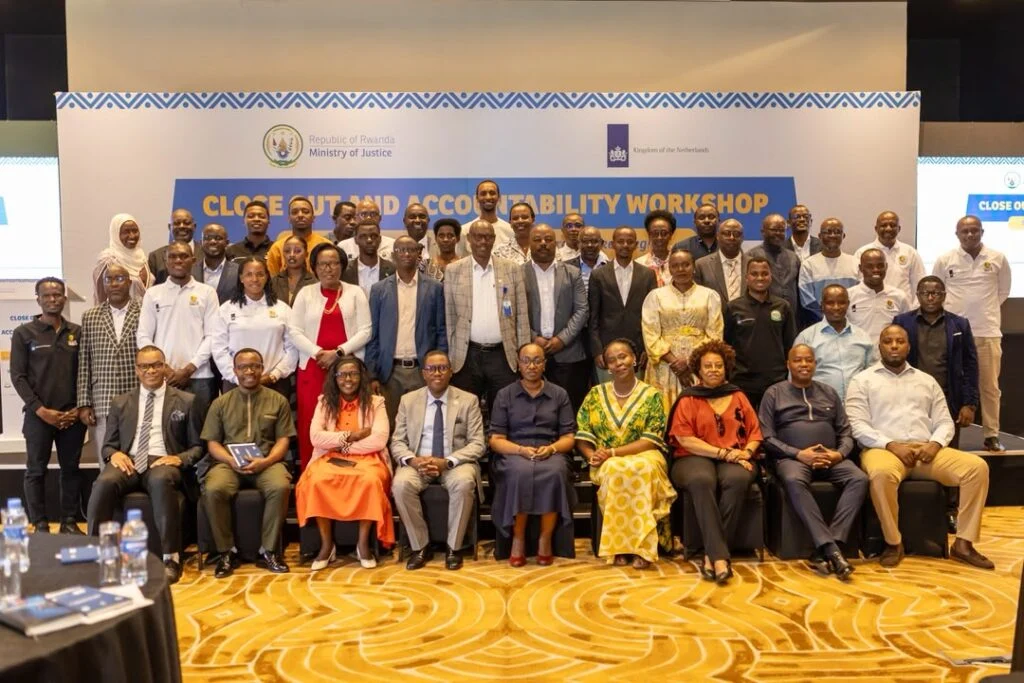
It is against this backdrop that International Alert has concluded a four-year regional initiative, Uhaki Bila Mipaka, aimed at bringing justice closer to border communities, strengthening local dispute resolution and promoting peaceful coexistence.
Implemented from December 2022 in partnership with iPeace and Pole Institute, with funding from the Kingdom of the Netherlands, the initiative concentrated its activities in Rwanda’s Rubavu and Rusizi districts, particularly communities around five border crossing points.
According to Betty Mutesi, International Alert’s Regional Director for Africa, supporting vulnerable young Rwandans detained in eastern DRC was among the project’s significant achievements.
“We managed to secure the release of approximately 2,500 of them and bring them back to Rwanda after they had been detained for reasons they knew nothing about,” Mutesi said, referring to young women and men held in different police detention facilities.
Strengthening access to justice at community level
Beyond its cross-border interventions, the initiative sought to address everyday barriers preventing residents of Rubavu and Rusizi from obtaining justice.
Through its legal aid services, it reached 26,959 people, provided legal assistance to 3,121 and secured legal representation for 253 individuals.
It also invested in community-based dispute resolution, training 593 Abunzi mediators, with 134 receiving additional coaching. Another 170 young people received training in conflict prevention and resolution, while 83 local leaders were equipped with alternative dispute resolution skills.
The Ministry of Justice says such interventions have contributed to strengthening the relationship between citizens and justice institutions.
Gahongayire Miriam, Head of the Department of Access to Justice at the Ministry, highlighted International Alert’s role in training community mediators and improving public understanding of the law.
“They have been supporting us in various ways, including the training of Abunzi and raising public awareness, particularly by educating the population about the laws they encounter in their daily lives,” she said.
The project also supported citizens in using Rwanda’s Integrated Electronic Case Management System (IECMS) to register and follow up court cases electronically. A further 442 participants were trained to use Mbaza, the country’s citizen complaints and feedback mechanism.
Its contribution extended nationally through a partnership with the Ministry of Justice to map alternative dispute resolution service providers across all 30 districts. Conducted by the Institute of Legal Practice and Development (ILPD), the exercise is intended to inform implementation of Rwanda’s National ADR Policy.
Keeping the gains alive
Despite insecurity and disruptions to cross-border cooperation, the implementing partners adapted their activities to maintain support for communities.
The project’s conclusion raises questions about the sustainability of its achievements, particularly the continued availability of legal aid, community mediation and institutional support.
The four-year intervention leaves behind trained mediators, citizens with greater knowledge of their legal rights and stronger links between communities and justice institutions.
But for people such as Amon, its impact is also measured in more immediate terms: the ability to seek assistance when confronted with injustice and, ultimately, to return home.