
By Senior Editor, China Africa News
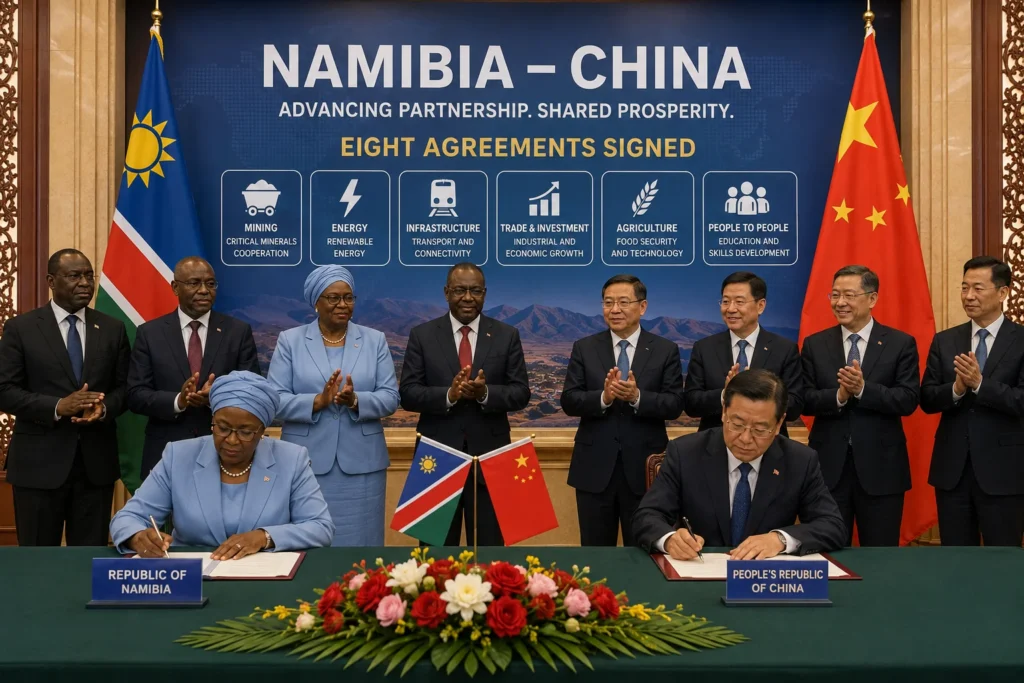
Beijing, July 13, 2026 — Namibia and China have signed eight cooperation agreements spanning mining, energy, infrastructure and agriculture, reinforcing a partnership that has grown increasingly important as both countries seek closer collaboration on trade, investment and critical minerals.
The agreements, concluded at the end of President Netumbo Nandi-Ndaitwah’s visit to Beijing, place renewed emphasis on industrial cooperation and the development of Namibia’s mineral resources, including uranium, lithium and rare earth elements. Officials from both governments said the partnership would extend beyond resource extraction to include technology transfer, skills development and greater value addition within Namibia.
The deals come as Namibia seeks to position itself as a regional centre for the processing of critical minerals, which are in growing demand for electric vehicles, renewable energy technologies and advanced manufacturing. Rather than exporting raw materials alone, the government has increasingly argued that future investment should support domestic industries capable of creating employment and expanding the country’s manufacturing base.
China has become one of Namibia’s most significant economic partners over the past three decades. It is the largest destination for Namibian exports, driven largely by uranium shipments, while Chinese investment has played a prominent role in mining, transport infrastructure and energy development. As global competition for strategic minerals intensifies, Namibia’s stable political environment and abundant natural resources have made it an increasingly attractive destination for Chinese investment.
The significance of the agreements extends beyond economics. They were signed during President Nandi-Ndaitwah’s first state visit outside Africa since taking office, a diplomatic decision that signals the priority Windhoek attaches to its relationship with Beijing. For China, the visit reinforces its long-standing engagement with Southern Africa at a time when it is seeking to deepen partnerships across the continent through trade, industrial cooperation and infrastructure investment.
During bilateral talks, the two governments agreed to elevate their relationship to what they described as a “China–Namibia community with a shared future for the new era,” reflecting an intention to broaden cooperation beyond commerce into science, technology, education and sustainable development.
For Namibia, the strengthened partnership comes at a pivotal moment. The country is pursuing an ambitious strategy to diversify its economy through mining, renewable energy and emerging industries such as green hydrogen. Access to investment, technology and international markets will be central to those ambitions, and China remains one of the few partners capable of providing financing, industrial expertise and a large market for Namibia’s exports.
The agreements also reflect a broader shift in China-Africa relations. While Chinese engagement on the continent was once defined largely by infrastructure lending and construction projects, recent cooperation has increasingly centred on industrial development, manufacturing and securing supply chains for the minerals needed to support the global energy transition.
Whether the latest agreements translate into tangible economic gains will depend on their implementation. But they underscore the strategic importance both governments attach to a relationship that has become a cornerstone of Namibia’s economic diplomacy and China’s engagement with resource-rich African economies