
By Senior Editor, China Africa News
KIGALI, Rwanda, July 11, 2026 — China and Rwanda reaffirmed their growing partnership on Thursday during a youth dialogue in Kigali, with officials from both countries portraying bilateral relations as a long-term strategic partnership rooted in shared development priorities, governance cooperation and expanding people-to-people exchanges.
Speaking at the China–Rwanda Youth Dialogue held at the Chinese Embassy in Kigali, China’s Ambassador to Rwanda, Gao Wenqi, said relations between the two countries were the result of deliberate political choices rather than historical circumstance.
“The relationship between China and Rwanda is not accidental,” Gao said, describing it as one built on mutual respect and a shared commitment to placing citizens’ welfare at the center of national development.
He argued that governance cooperation has become a defining feature of bilateral relations, with each country drawing lessons from the other’s development experience. Gao also urged young people from both nations to play a greater role in strengthening ties and translating broader global development objectives into practical initiatives that improve people’s lives.
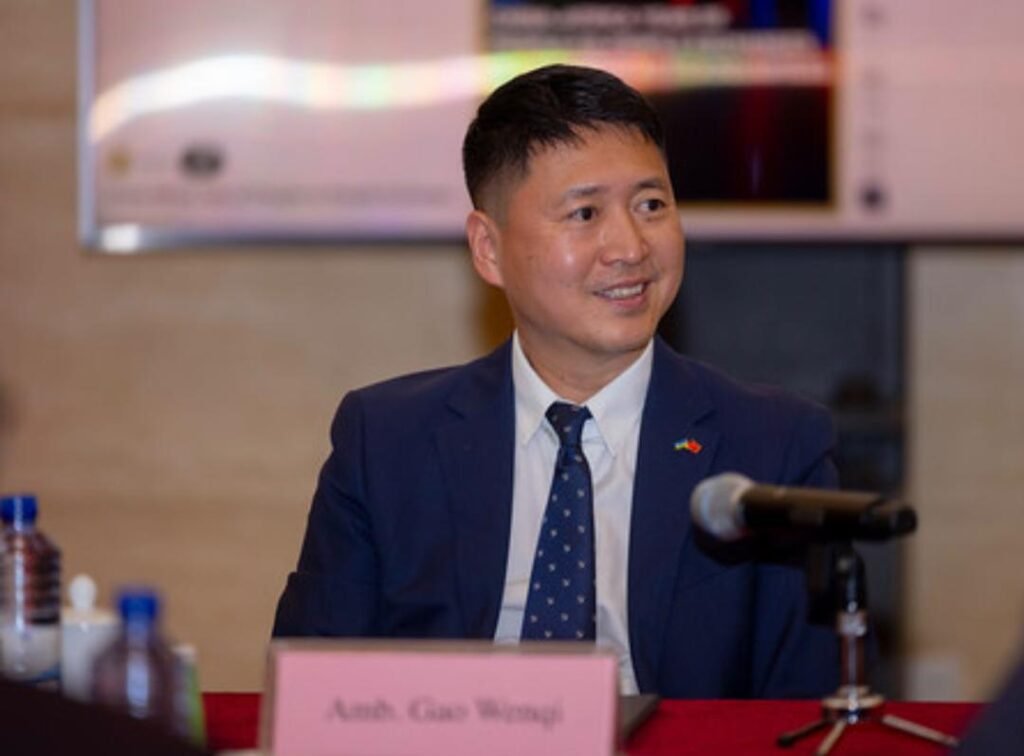
The event brought together more than 40 young professionals, students and representatives from various institutions in Rwanda and China, alongside officials and development partners, to discuss cooperation in areas ranging from development and education to cultural exchange.
Representing Rwanda’s Ministry of Foreign Affairs and International Cooperation, Virgile Rwanyagatare, Director General for Asia and the Pacific, said exchanges between the ruling parties of the two countries have contributed to closer bilateral relations.
He congratulated the Communist Party of China (CPC) on its 105th anniversary and said cooperation between the CPC and Rwanda’s ruling Rwandan Patriotic Front (RPF-Inkotanyi) has strengthened political dialogue between Beijing and Kigali.
Rwanyagatare also emphasized the importance of youth engagement, encouraging young people from both countries to deepen mutual understanding, exchange ideas and contribute to sustainable development and shared economic growth.
The dialogue comes as Rwanda and China commemorate 55 years of diplomatic relations, established in 1971. Over the past five decades, the relationship has expanded beyond diplomacy to encompass trade, infrastructure, healthcare, agriculture, education and technology.
China has become one of Rwanda’s most significant development partners, financing and constructing major infrastructure projects while increasing investment in manufacturing and industrial development. Rwanda, meanwhile, has positioned itself as one of Africa’s fastest-growing economies and has pursued closer engagement with Beijing as part of its broader strategy to diversify international partnerships.
The two countries have also expanded cooperation through the Forum on China–Africa Cooperation (FOCAC), Beijing’s principal platform for engagement with African governments, which has supported initiatives in infrastructure, capacity building, public health and digital connectivity across the continent.
China’s engagement in Rwanda reflects a broader expansion of its presence in Africa, where Beijing has become the continent’s largest bilateral trading partner and a major source of infrastructure financing.
While supporters argue that Chinese investment has accelerated economic development and filled critical infrastructure gaps, critics have raised concerns in some countries over debt sustainability, transparency and long-term economic dependence. Rwanda, however, has generally been viewed as one of China’s more stable and pragmatic partners in Africa, with cooperation extending into areas such as vocational training, technology transfer and public administration.
Participants at Thursday’s dialogue said the forum provided an opportunity to broaden perspectives, strengthen people-to-people ties and foster closer cooperation between the next generation of Rwandan and Chinese leaders.
As both governments seek to deepen economic and political cooperation, officials portrayed youth exchanges as an increasingly important pillar of a relationship that has evolved significantly since diplomatic ties were first established more than half a century ago.