
By Senior editor, China Africa News
Beijing, July 16, 2026 — China has deployed a team of public health experts to support the international response to the ongoing Ebola outbreak affecting the Democratic Republic of the Congo (DRC) and neighboring Uganda, reinforcing Beijing’s long-standing commitment to health cooperation across Africa.
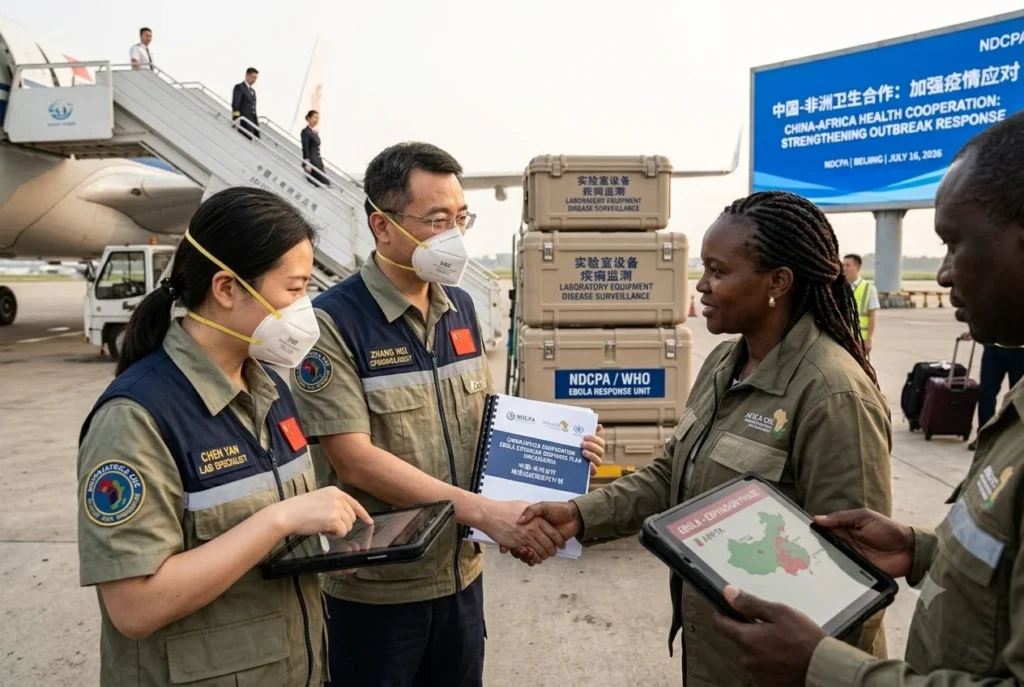
According to China’s National Disease Control and Prevention Administration (NDCPA), two specialists have been dispatched at the invitation of the Africa Centres for Disease Control and Prevention (Africa CDC) and the World Health Organization (WHO). The experts are expected to work alongside African and international health authorities on disease surveillance, laboratory testing, epidemiological investigations, and outbreak control measures.
The deployment comes as the Ebola outbreak continues to expand in eastern DRC. Health officials say the epidemic, caused by the Bundibugyo strain of the Ebola virus, has spread rapidly since it was first confirmed in May. Thousands of suspected and confirmed cases have been reported, placing enormous pressure on healthcare systems in affected communities.
Chinese officials said the mission is part of broader international efforts to contain the outbreak before it spreads further across the region. In addition to providing technical expertise, the team will help strengthen laboratory capacity, improve disease monitoring, and support local health workers responding on the front lines.
China has played an increasingly visible role in Africa’s public health sector over the past two decades. During the West African Ebola epidemic of 2014–2016, Beijing sent medical personnel, mobile laboratories, protective equipment, and emergency funding to several affected countries. More recently, China has expanded its health partnerships through hospital construction, medical training, vaccine cooperation, and support for the Africa CDC.
The latest deployment also highlights the growing importance of international collaboration in responding to infectious disease outbreaks. Organizations including the WHO, Africa CDC, Médecins Sans Frontières (MSF), and national health authorities have warned that controlling the outbreak will require sustained investment in surveillance, rapid diagnosis, treatment, community engagement, and cross-border coordination.
Health experts caution that the Bundibugyo strain presents additional challenges because there are currently no widely approved vaccines specifically designed for this variant. As a result, containment efforts rely heavily on early detection, contact tracing, isolation of patients, infection prevention measures, and public awareness campaigns.
China’s latest contribution reflects the broader trend of international partners working together to strengthen Africa’s capacity to respond to public health emergencies. As the outbreak continues, health authorities say global cooperation will remain essential to limiting transmission, protecting healthcare workers, and preventing the virus from spreading to new areas.