
By Cremilda Macuacua, China Africa News
Luanda, June 17, 2026 — Angola is intensifying efforts to secure Chinese financing for one of its most strategic energy projects, underscoring the evolving nature of China–Africa economic cooperation.
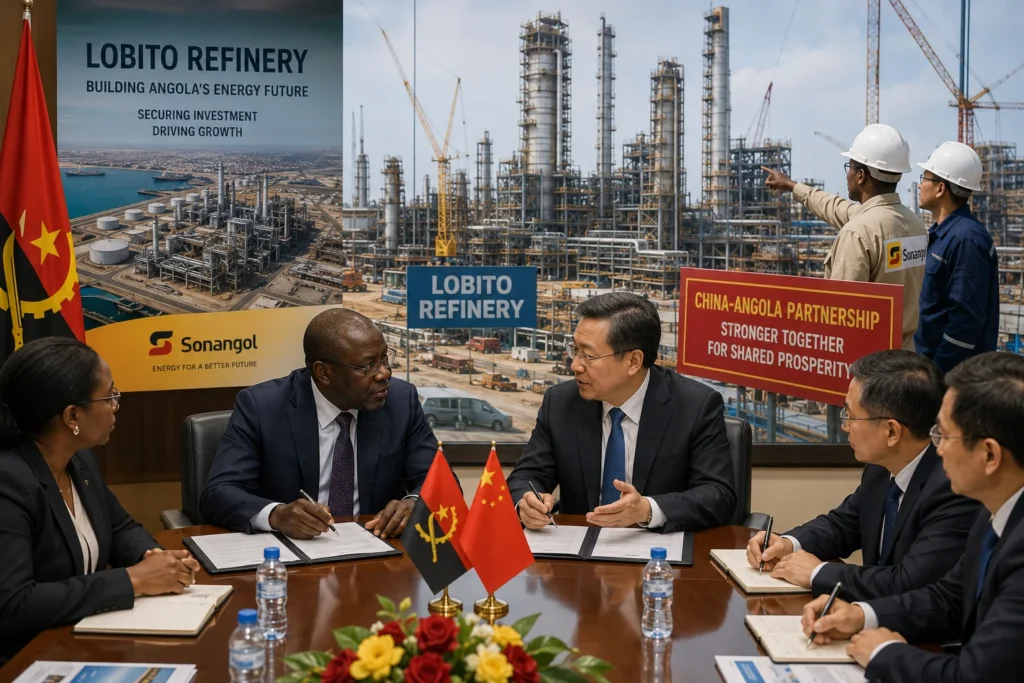
State-owned energy giant Sonangol is in discussions with Chinese financial institutions over a proposed $4.8 billion loan that would help fund the construction of the Lobito Refinery, a major industrial project designed to strengthen Angola’s domestic fuel-processing capacity. The development comes as the company recently secured an additional $2.65 billion from a consortium of international banks to support broader operational and investment activities.
The refinery project is central to Angola’s long-term strategy of reducing its dependence on imported refined petroleum products despite being one of Africa’s leading crude oil producers. Once completed, the facility is expected to significantly expand local refining capacity, improve energy security, and create opportunities for fuel exports to neighboring countries.
Beyond its economic significance, the negotiations also signal a potential revival of financial ties between Angola and China. Over the past decade, Luanda sought to reduce its reliance on Chinese credit, particularly oil-backed loans that had become a hallmark of China’s engagement with African resource-rich economies. The current talks suggest a more cautious and commercially driven approach, with officials indicating that the proposed financing would not be secured against future oil exports.
For China, participation in the Lobito project aligns with a broader shift in its Africa strategy. Rather than focusing exclusively on transport infrastructure, Chinese institutions are increasingly supporting industrial and energy projects that can contribute directly to local production and economic transformation. The refinery therefore represents more than a financing transaction; it reflects a growing emphasis on industrialization as a pillar of China–Africa cooperation.
However, the project’s success will depend on Angola’s ability to secure sustainable financing and deliver the refinery within budget and on schedule. Large-scale energy projects across the continent have often faced delays, cost overruns, and funding challenges. As negotiations continue, investors and policymakers alike will be watching closely to determine whether the Lobito Refinery can become a model for a new generation of Africa’s industrial development.
The outcome of the talks could shape not only Angola’s energy future but also the next chapter of China’s economic engagement with Africa.