
By staff writter, China Africa News
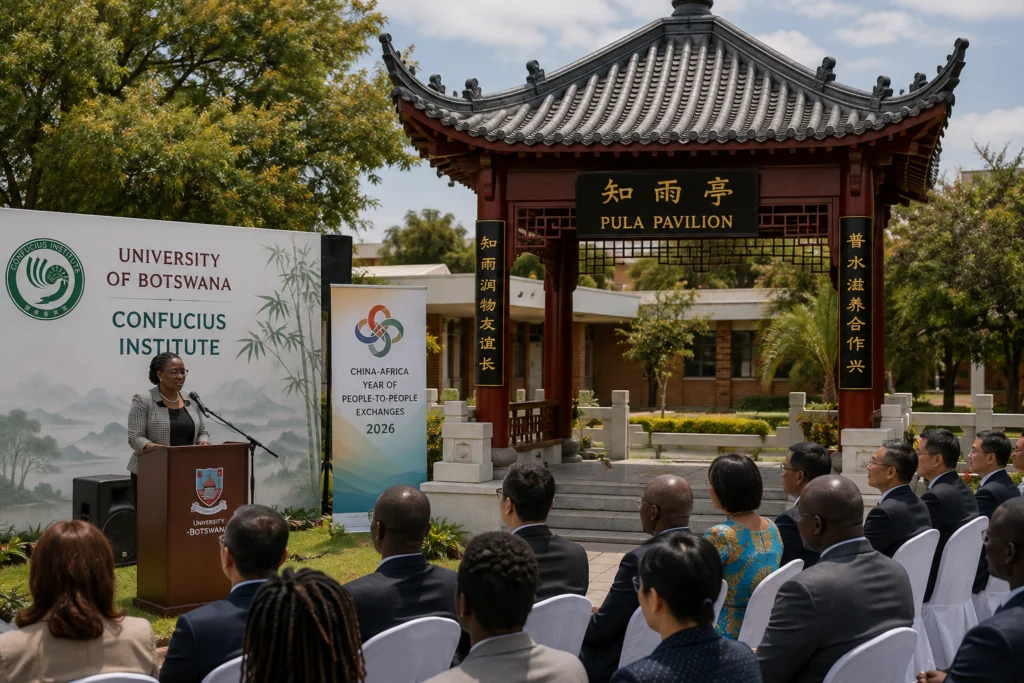
GABORONE, Botswana, August 13, 2026 — On the campus of the University of Botswana, a small Chinese-style pavilion is taking on a meaning far greater than its size.
Unveiled this week at the university’s Confucius Institute, the pavilion has become a new symbol of the growing friendship between Botswana and China a relationship built not only through government ties, trade and investment, but also through education, language, culture and human connection.
Maria Nnyepi, the university’s deputy vice chancellor, described the Confucius Institute as a cornerstone of Botswana-China relations, particularly in advancing educational and cultural exchange.
Donated by the Chinese Enterprises Association in Botswana, the pavilion carries two names: Zhiyu Pavilion, a Chinese name meaning roughly “to know the rain,” and Pula Pavilion in English.
The name Pula carries particular significance in Botswana.
“Pula” means “rain” in Setswana. In a country where rainfall is closely tied to livelihoods and national identity, the word means much more than weather. Pula is also Botswana’s national motto and is associated with prosperity, blessing and good fortune.
The pavilion’s name therefore creates a quiet connection between two cultures through a shared symbol.
In Chinese culture, rain has long carried poetic and symbolic meanings. In Botswana, it is a precious gift that sustains communities, agriculture and livelihoods. Bringing these meanings together gives the pavilion a distinctly human message: different cultures can find common ground even in the most universal experiences.
That spirit lies at the heart of the Confucius Institute
For years, the institute at the University of Botswana has given Batswana students an opportunity to learn Chinese language and culture while gaining a window into a country thousands of kilometres away.
But meaningful cultural exchange cannot be a one-way journey.
It is not simply about learning another culture; it is also about having the opportunity to share one’s own traditions, history and identity. Nnyepi’s remarks at the unveiling reflected that principle learning from other cultures while ensuring that Botswana’s own culture is also understood and appreciated.
In that sense, the pavilion is more than a structure.
It is a physical space where two cultures can meet, learn from one another and build relationships.
Its unveiling also comes at a significant moment. 2026 has been designated the China-Africa Year of People-to-People Exchanges, placing renewed emphasis on connections among students, educators, communities and ordinary citizens.
At the University of Botswana, those connections are already taking shape
Earlier this year, the Confucius Institute hosted the Botswana final of the “Chinese Bridge” competition for primary school students. Young participants demonstrated their Chinese-language skills through singing, dancing, storytelling, painting, martial arts and poetry.
For a child learning a few words of another language, such an event may appear small.
But international relationships are rarely built only through major agreements or official ceremonies. They are also built in classrooms, on university campuses and through the curiosity of young people discovering another culture for the first time.
A pavilion may not change the course of a relationship on its own
But it can provide a place for people to gather, exchange ideas and understand one another.
And perhaps that is what makes Pula Pavilionsuch a fitting symbol of Botswana-China friendship.
In Botswana, rain represents hope, prosperity and life. In the pavilion’s Chinese name, it carries a different but complementary cultural meaning.
Together, the two names tell a simple story: friendship, like rain, can bring people together, nurture connections and help something lasting take root