
By Senior Editor, China Africa News
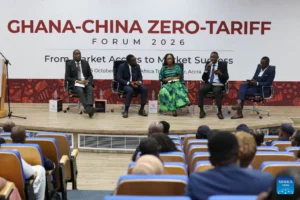
BEIJING/PRETORIA, June 23, 2026 — South Africa is intensifying efforts to attract Chinese investment in manufacturing, logistics, energy, and technology sectors, as it participates in one of China’s flagship international supply chain exhibitions this week.
Deputy President Paul Mashatile and a high-level delegation have been meeting Chinese companies and global investors at the China International Supply Chain Expo, presenting South Africa as a key entry point into African markets and a potential hub for regional industrial expansion.
The outreach comes at a time when global supply chains are undergoing significant restructuring. Geopolitical tensions, energy market volatility, and shifting trade alliances have pushed many countries to reassess production networks and diversify sourcing strategies. For African economies, this has created both risks and opportunities.
South Africa’s message in Beijing is clear: it wants to be positioned not only as a raw materials exporter, but as a manufacturing and logistics partner within global value chains.
The country already has the most industrialized economy on the continent, with established automotive, mining, finance, and manufacturing sectors. However, it continues to face structural challenges, including slow growth, high unemployment, and energy constraints that have limited industrial expansion.
By engaging Chinese investors, South African policymakers are seeking to address these constraints while also attracting new capital into strategic sectors.
China, for its part, has become one of South Africa’s largest trading partners and a growing source of investment. Chinese firms are already active in infrastructure, energy, telecommunications, and manufacturing across the country. The current engagement signals an effort to deepen and diversify that relationship further.
For Beijing, South Africa offers more than just a national market. It provides access to the wider African continent through established trade routes, regional agreements, and logistical networks. This makes South Africa a strategic node in China’s broader engagement with Africa.
The evolving relationship reflects a broader shift in China-Africa economic cooperation. While earlier phases focused heavily on infrastructure development railways, ports, and energy projects there is now increasing emphasis on industrial integration and supply chain participation.
South Africa’s participation in the supply chain expo highlights this transition. Rather than seeking only infrastructure financing or commodity trade, the country is positioning itself within the operational layers of global production systems.
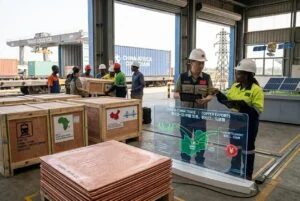
Manufacturing and logistics are central to this strategy. South African officials have highlighted opportunities in automotive production, renewable energy equipment, mineral beneficiation, and industrial logistics networks. These sectors are seen as critical for job creation and long-term economic resilience.
However, analysts caution that attracting investment alone will not resolve deeper structural challenges. Energy reliability, regulatory stability, and workforce development remain key constraints on industrial growth.
The energy factor is particularly significant. Persistent electricity shortages have disrupted production across multiple sectors in recent years, affecting investor confidence and industrial output. Any expansion of manufacturing partnerships will depend heavily on improvements in energy infrastructure and supply stability.
Despite these challenges, South Africa’s engagement in China reflects a broader confidence among African policymakers that global economic fragmentation can be leveraged into opportunity. As companies seek to diversify supply chains away from concentrated production hubs, Africa is increasingly being viewed as a potential alternative manufacturing base.
China’s role in this transition is central. With advanced manufacturing capacity and global investment reach, Chinese firms are well positioned to support industrial development abroad while expanding their own international footprint.
For South Africa, this creates a potential win-win dynamic: access to capital, technology transfer, and industrial partnerships on one side, and expanded market access for Chinese firms on the other.
Still, the outcome will depend on execution. Past investment commitments across Africa have sometimes fallen short of expectations due to infrastructure bottlenecks, policy uncertainty, and implementation delays. Ensuring that new agreements translate into real industrial capacity will be the key test.
The current discussions in Beijing therefore represent more than routine diplomatic engagement. They reflect a broader repositioning of South Africa within global trade networks, and a gradual deepening of China-Africa economic ties beyond traditional sectors.
If successful, this approach could help South Africa strengthen its manufacturing base while offering Chinese companies a strategic platform for continental expansion.
In that sense, the supply chain expo is not just a forum for trade promotion it is a window into how global production systems are being reshaped, with Africa increasingly part of the conversation.