

By Senior Editor, China Africa News
KIGALI, Rwanda, June 13, 2026 — As health authorities race to contain a regional Ebola outbreak in parts of eastern Democratic Republic of Congo and Uganda, Rwanda is confronting a different challenge: preventing a public health crisis beyond its borders from becoming an economic one at home.
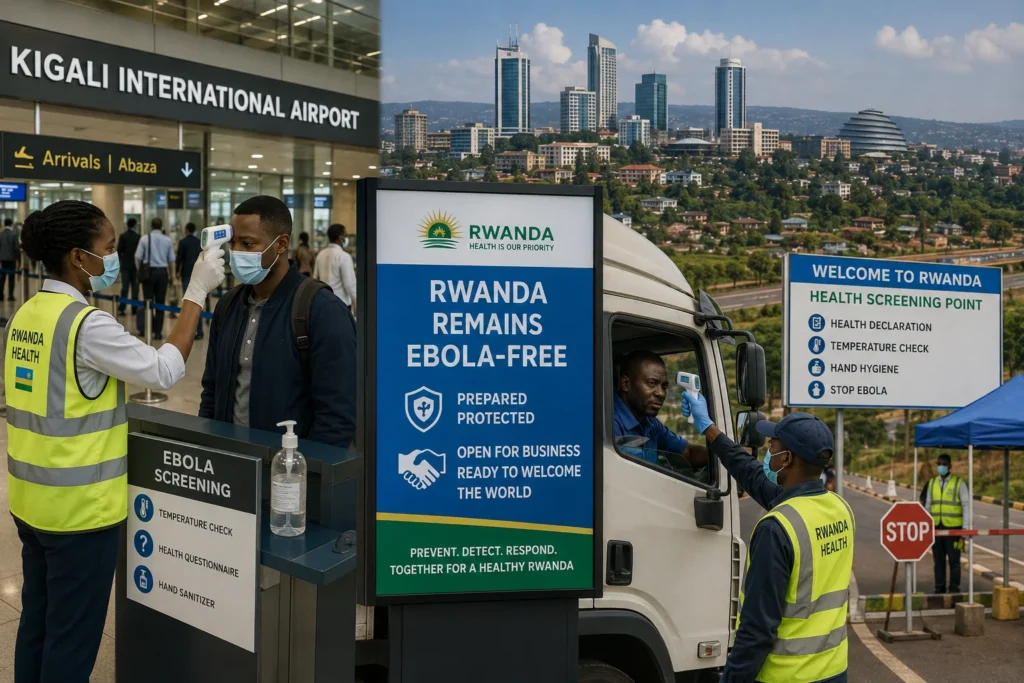
The East African nation, which has positioned itself as one of Africa’s most attractive destinations for foreign investment, tourism and international conferences, is intensifying surveillance and border controls while delivering a clear message to global investors: Rwanda remains Ebola-free, open for business and prepared for any eventuality.

In an interview, Rwanda’s Minister of Health Dr Sabin Nsanzimana said the country has activated a comprehensive preparedness framework designed to prevent the virus from crossing its borders, even as neighboring countries continue efforts to contain the outbreak.
“Rwanda has no Ebola cases,” the minister said. “Our focus is to ensure it stays that way through prevention, early detection and rapid response.”
The reassurance comes at a sensitive moment for a country that has spent years cultivating a reputation for stability, efficiency and predictability, qualities increasingly prized by international investors navigating a volatile global economy.
While the current outbreak has generated concern across the region, health officials in Kigali argue that geographical proximity alone should not be mistaken for epidemiological risk.
“We believe assessments should be based on facts, science and evidence,”
The minister said, responding to some international advisories that have grouped Rwanda among countries facing elevated Ebola-related concerns. “It is important to distinguish between a country experiencing an outbreak and a country that has successfully prevented one.”
A Regional Threat, Not a Domestic Outbreak
The Ebola outbreak, officially recognized by international health authorities in May, has largely affected areas of eastern Democratic Republic of Congo, with additional cases reported in Uganda.
Rwandan officials say they have closely monitored developments since the earliest reports emerged and have maintained constant coordination with regional and international health partners.
For Rwanda, the challenge is familiar.
The country shares borders with both the Democratic Republic of Congo and Uganda and has repeatedly found itself on high alert during previous Ebola outbreaks. Yet despite multiple regional epidemics over the years, Rwanda has never recorded a domestic Ebola outbreak.
Officials attribute that record to a combination of aggressive surveillance, strong border management, laboratory readiness and a health system designed to rapidly identify and isolate suspected cases.
“Ebola is not an airborne disease,” the minister explained. “Transmission requires close contact with infected body fluids, which means outbreaks can be contained when health systems identify cases early and respond effectively.”
That reality shapes Rwanda’s strategy.
Rather than waiting for a confirmed case, authorities have invested heavily in preparedness, conducting simulations, training frontline health workers, strengthening laboratory capacity and maintaining emergency response teams capable of immediate deployment.
Screening, Surveillance and Preparedness.
At Kigali International Airport, automated thermal screening systems monitor arriving passengers for fever, one of the primary symptoms associated with Ebola and other viral hemorrhagic diseases.
Travelers arriving from areas considered high-risk undergo additional health assessments and monitoring procedures. Similar measures have been reinforced at land border crossings, particularly along Rwanda’s western frontier.
The government has also expanded diagnostic capacity, enabling health authorities to quickly distinguish Ebola symptoms from more common illnesses such as malaria, which can initially present in similar ways.
The emphasis, officials say, is not only on preventing importation of cases but also on ensuring that any suspected infection can be identified and managed before wider transmission occurs.
Public health experts often note that Ebola presents a unique paradox: while it can be highly lethal, it is generally easier to contain than airborne diseases when surveillance systems function effectively.
For Rwanda, that understanding has shaped years of investment in preparedness infrastructure.
Protecting an Economic Success Story
Beyond the immediate health implications, the government is acutely aware of the economic consequences that perceptions of risk can generate.
Even in countries without confirmed cases, Ebola outbreaks have historically disrupted tourism, trade, aviation and investment flows across entire regions.
For Rwanda, where international conferences, foreign direct investment and cross-border commerce have become central pillars of economic growth, maintaining confidence is as important as maintaining vigilance.
The minister argued that the country’s health-security architecture forms part of a broader ecosystem that supports economic development.
“Investors look for environments where systems work,”
Rwanda’s Minister of Health – Dr Sabin Nsanzimana said.
“Health security is part of that equation, just as much as physical security, governance and ease of doing business.”
The government has therefore sought to reassure international partners that daily life and economic activity continue uninterrupted.
Flights continue to operate normally. International conferences remain on schedule. Foreign businesses continue to expand operations. Tourist arrivals have not been subject to restrictions.
Officials point to those indicators as evidence that global confidence in Rwanda’s preparedness remains largely intact.
Containing Outbreaks at the Source
Rwanda’s strategy extends beyond its own borders.
The minister emphasized that regional cooperation remains the most effective defense against future outbreaks, arguing that supporting affected countries is both a public health necessity and an economic imperative.
“The best protection for all of us is to contain the outbreak where it exists,”
He said.
“As long as an outbreak remains active anywhere, there is a shared responsibility to help bring it under control.”
That approach reflects a broader lesson reinforced by recent global health emergencies: infectious diseases rarely respect national boundaries, and preparedness increasingly depends on collective action.
For now, Rwanda’s message is one of cautious confidence.
Health authorities continue to monitor developments across the region, maintain heightened surveillance and refine emergency-response mechanisms. Yet officials insist there is no basis for alarm within the country itself.
For international investors, particularly those from China, Europe, North America and other major economic partners the government’s message remains unequivocal.
Rwanda, they say, remains one of Africa’s safest and most stable destinations for business, with no Ebola cases, functioning safeguards and a determination to protect both public health and economic continuity.
In a region confronting one of the world’s most closely watched infectious diseases, Rwanda’s objective is clear: to ensure that preparedness, rather than panic, defines the national response.