
Cremilda Macuácua, China Africa News
Maputo, 2 June 2026 — China and Mozambique continue to strengthen their long-standing relationship through cultural diplomacy and people-to-people exchanges. The launch of the 2026 China-Africa Cultural and Artistic Exchange Tour and the “Silk Road Art Dialogue” Exhibition in Maputo demonstrates the growing importance both countries place on cultural cooperation as a pillar of bilateral relations.
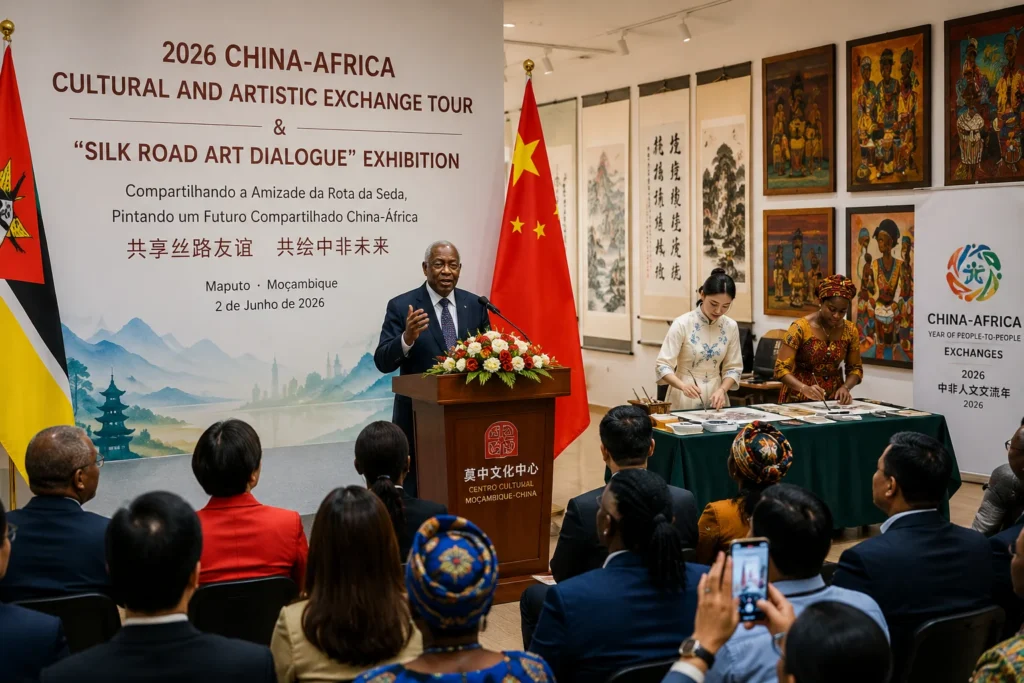
Held at the Mozambique-China Cultural Center in the Mozambican capital, the event brought together hundreds of participants from political, cultural, educational, and business sectors. Under the theme “Sharing Silk Road Friendship, Painting a Shared China-Africa Future,” the initiative seeks to promote mutual understanding and deepen friendship between the peoples of China and Mozambique through art and cultural engagement.
The exhibition showcased a diverse collection of Chinese and Mozambican artworks, including traditional Chinese ink paintings, calligraphy, and contemporary African artistic expressions. Through these displays, visitors were given a unique opportunity to appreciate the cultural heritage, creativity, and shared aspirations of both nations.
Speaking at the opening ceremony, former Mozambican President Joaquim Chissano highlighted the enduring friendship between Mozambique and China. He emphasized that cultural exchanges play a crucial role in fostering understanding among peoples and contribute to the continued growth of bilateral relations. His remarks reflected the broader significance of cultural diplomacy in strengthening cooperation beyond economic and political partnerships.
The event also featured interactive workshops and cultural activities, allowing participants to engage directly with Chinese artistic traditions. Visitors explored Chinese ink-painting techniques and learned about the philosophy and history behind the art form. Such exchanges help build lasting connections by encouraging dialogue, learning, and appreciation across cultures.
For many Mozambican artists and cultural practitioners, the exhibition served as an important platform for collaboration. Local visual artist Naguib Elias Abdula noted that the initiative could open new opportunities for cooperation in painting, music, dance, theatre, and other creative fields. These interactions have the potential to enrich artistic communities in both countries while fostering innovation and cultural diversity.
The Maputo exhibition forms part of the broader China-Africa Year of People-to-People Exchanges, an ambitious program designed to promote cultural, educational, tourism, and youth cooperation across the African continent. Through hundreds of activities planned throughout the year, China and African nations are seeking to strengthen people-centered partnerships and create deeper bonds between their societies.
As China and Mozambique continue to expand their relationship, cultural exchanges such as the “Silk Road Art Dialogue” Exhibition highlight the value of soft diplomacy in building trust and friendship. Beyond the artworks on display, the event represents a shared commitment to dialogue, mutual respect, and a common future shaped by cooperation and cultural understanding.